
How to Search Erie County Traffic Court Records
Most Erie County traffic cases are magisterial district court records, so the statewide Unified Judicial System portal is the main public tool. You can search by the citation number printed on the ticket or by the driver's name. The citation number gives an exact hit, while a name search needs narrowing by county and docket type.
- Find the citation number printed on the ticket if you have it.
- Open the UJS Case Search and choose Citation Number mode.
- Enter the number exactly, including the dash, such as A5368532-1.
- If you lack the citation, search by Participant Name and narrow to Erie - 06 and a traffic docket type.
- Open the docket to see the issuing magisterial office, the charge, and the disposition.
If the docket shows a specific magisterial office, that office handles hearings, payment, and plea questions for the case.
Which Courts Handle Traffic Cases in Erie County
Traffic matters in Erie County are primarily Magisterial District Court records. The magisterial judges handle citations, summary vehicle offenses, and hearings. A case stays at that level unless it is appealed or charged as a more serious crime. When a summary traffic conviction is appealed, the Clerk of Courts processes the summary appeal to the Court of Common Pleas.
The Clerk of Courts specifically accepts summary appeals from magisterial decisions, including traffic code violations, for a $43.50 non-refundable fee. That gives a clear local link between a traffic citation and the criminal court clerk on appeal. To find the magisterial office handling a case, see the full list on the Court of Common Pleas page.
Types of Traffic Cases on Record
Traffic records cover a range of vehicle matters, from minor citations to serious offenses that cross into criminal court. The list below shows the common types in Erie County.
- Summary traffic citations, such as speeding or signal violations.
- Non-traffic summary offenses handled by the same magisterial courts.
- Failure-to-respond and failure-to-pay matters that can trigger a warrant or suspension.
- Summary appeals taken to the Court of Common Pleas.
- DUI and serious vehicle offenses charged as crimes, which move to criminal court.
What Erie County Traffic Court Records Show
A traffic docket carries a standard set of fields. It records the charge, the plea, the hearing, the disposition, and any money owed. The table below lists what a typical Erie County traffic record shows.
| Field | What It Shows |
|---|---|
| Citation Number | The number printed on the ticket |
| MJ Docket Number | The magisterial case identifier |
| Defendant | The cited driver |
| Issuing Authority | The magisterial district judge and agency |
| Vehicle Code Section | The statute, subsection, and description |
| Plea and Disposition | The plea entered and the outcome |
| Fines and Costs | Fine, costs, and any surcharges |
| Warrant or Suspension | Entries for failure to respond or pay |
Note: Points and license actions are reported separately to the state driver record, which is a different file from the court docket.
Searching by Citation Number vs by Name
The portal offers more than one way to find a traffic case, and the fields change with the mode. A citation search is exact. A name search is broad and needs filters. The table shows the fields most useful for an Erie County traffic search.
| Field Label | Type | Required | Notes / Format |
|---|---|---|---|
| Citation Number | Text | For citation search | Include the dash, like A5368532-1 |
| Participant Name | Text | Alternative | Narrow by Erie County and docket type |
| County | Dropdown | Conditional | Select Erie |
| Judicial District | Dropdown | Conditional | Select Erie - 06 |
| MDJS Court Office | Dropdown | Conditional | Select the Erie magisterial office if known |
| Docket Type | Dropdown | Optional | Traffic, Summary Appeal, or Criminal for DUI |
| Date Filed | Date | Optional | Narrows a broad name search |
Paying or Contesting an Erie County Traffic Ticket
A traffic citation gives you choices, and the right one depends on the ticket. You can pay, which often counts as a plea, or you can contest it at a hearing. Reading the citation and the court instructions first is important, because paying may be treated as an admission for some offenses.
- Read the citation for the response deadline and instructions.
- Decide whether to pay or to request a hearing to contest.
- To pay online, use the PAePay portal only if the case is eligible.
- To contest, follow the plea or hearing instructions or contact the magisterial office.
- Respond before the deadline to avoid a warrant or license suspension.
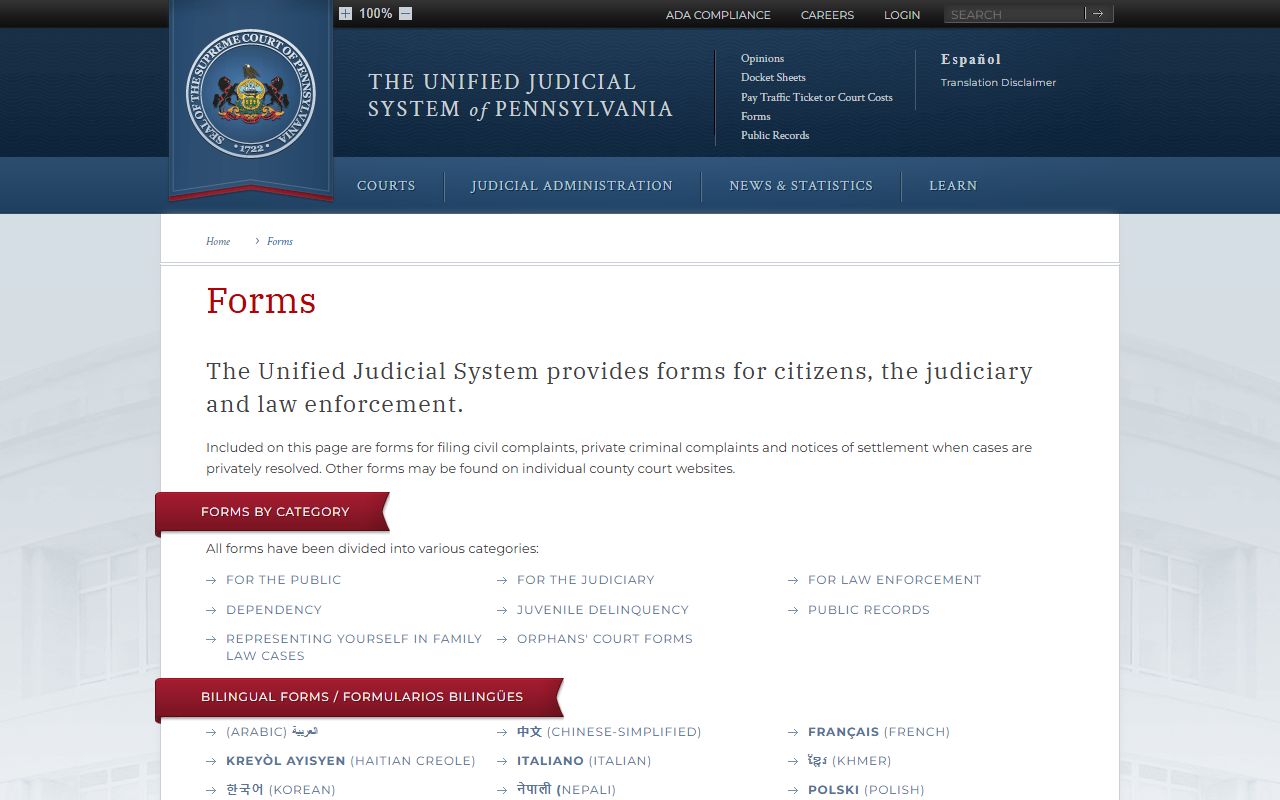
The Pennsylvania courts also publish official forms, which can help with traffic and summary matters.
You can find statewide forms on the Pennsylvania court forms page.
Using the official forms and the court's own payment channels avoids third-party fees and confusion.
Public Access Laws for Traffic Court Records
Traffic court records are court case records, so they follow the Unified Judicial System's public access policy rather than the Right-to-Know Law. Many magisterial traffic dockets are public on the statewide portal. The same limits apply as with other court records: juvenile, sealed, expunged, and limited-access matters may not display.
Failure to respond to a citation carries consequences under state law. A failure to respond or to pay fines and costs can lead to a license suspension under 75 Pa.C.S. § 1533. Acting on a citation early is far easier than clearing a warrant or a suspension later.
The statute that ties failure to respond to license consequences is published in the Pennsylvania code.
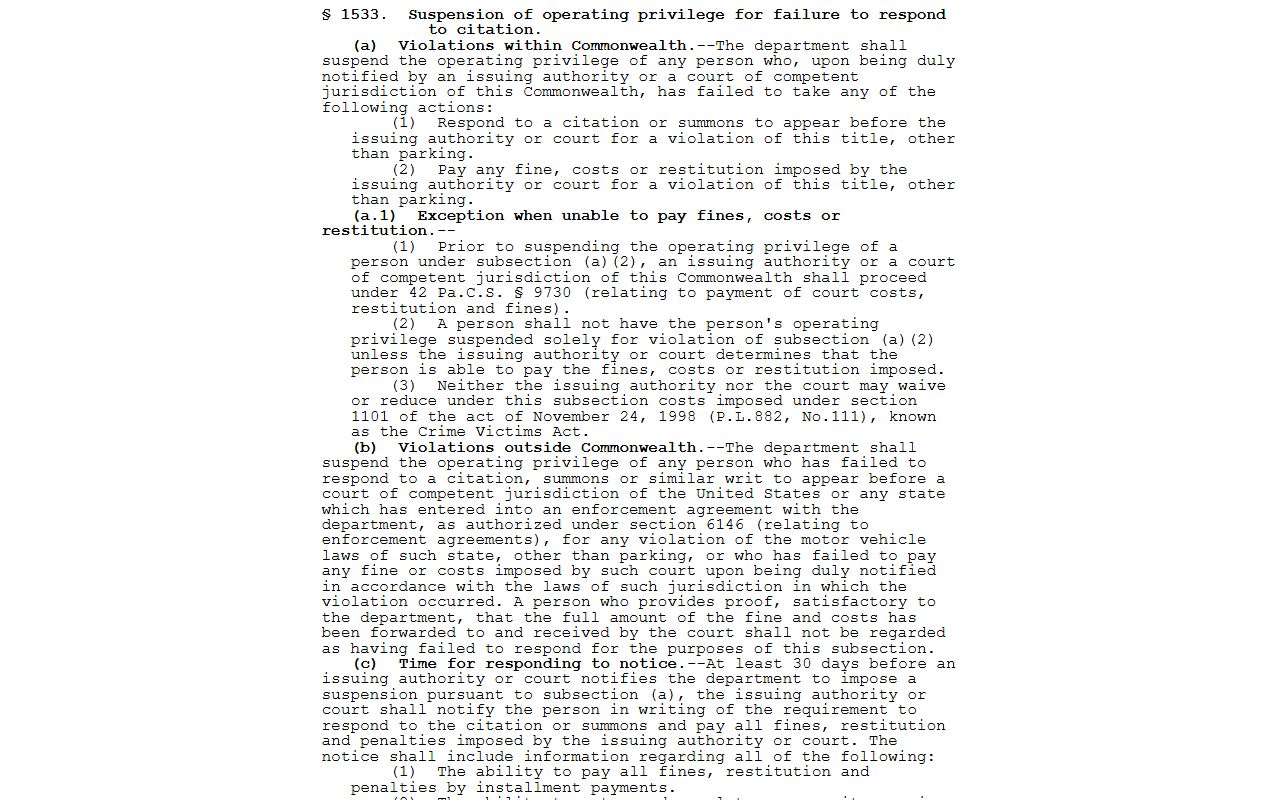
That is why ignoring a ticket is the costliest option, since it can add a warrant and a license hold on top of the original fine.
Court Traffic Records vs State Driver Records
These are two different files, and confusing them is a common mistake. The court traffic record is the docket from the magisterial court or, on appeal, the Court of Common Pleas. The state driver record is kept by the Pennsylvania Department of Transportation and tracks license status, points, and suspensions. One does not replace the other.
| Court Traffic Record | State Driver Record | |
|---|---|---|
| Source | Magisterial court or Common Pleas on appeal | Pennsylvania Department of Transportation |
| What it shows | Citation, plea, hearing, disposition, fines | License status, points, suspensions |
| Where to access | UJS docket portal or the court office | PennDOT driver history |
| How to correct | Through the court that handled the case | Through PennDOT |
A certified court disposition and a PennDOT driver abstract serve different purposes, so be sure you are requesting the one you actually need.
CDL and Commercial Driver Records
Commercial drivers face extra exposure on traffic matters. A disposition that seems minor for a regular license can carry separate reporting consequences for a commercial driver license. Some options that reduce points or penalties for ordinary drivers may not apply the same way to a CDL holder.
Because the stakes are higher, CDL drivers should get specific legal advice before pleading to or paying a citation. A traffic court record and the commercial reporting consequences are connected but not identical, and an attorney can explain how a particular disposition affects a commercial license.
DUI and DWI Cases
DUI is not a simple traffic ticket. A driving under the influence charge is a criminal matter that can begin at the magisterial level for a preliminary arraignment and hearing, then move to the Court of Common Pleas if held for court. Other serious vehicle offenses can follow the same path into criminal court.
Because DUI runs through the criminal system, its records sit with the Clerk of Courts and on the criminal docket rather than the simple traffic record. For that process, bail, and the criminal record, see Erie County arrest records.
Diversion and Driver-Safety Options
Pennsylvania offers paths that can reduce the impact of some cases, though the options depend on the charge and the driver's history. For eligible DUI cases, the Accelerated Rehabilitative Disposition program is one diversion route, handled through the criminal court rather than the traffic counter. For ordinary citations, plea and hearing choices at the magisterial level shape the outcome.
Eligibility rules change and depend on the specific offense, so confirm any program with the court or an attorney rather than assuming it applies. The magisterial office on the docket can explain the choices for a summary traffic case, while diversion for a criminal vehicle offense runs through the Court of Common Pleas.
Sealing or Expunging Traffic Records
Some traffic and summary records may be eligible for expungement or limited access, the same Pennsylvania tools that apply to other criminal records. Summary offenses can qualify for expungement after statutory conditions are met. The petitions are filed through the criminal court using the Clerk of Courts forms.
Eligibility turns on the exact case outcome and the waiting period, so the safe step is to check the forms and rules before filing. For how expungement and limited access work, and the forms involved, see the Erie County Clerk of Courts and arrest records.
Fees for Traffic Record Copies
Fees depend on the office and the service. The county publishes a few set amounts, while magisterial copy fees come from each office. The table below lists the confirmed fees tied to traffic matters.
| Service | Fee |
|---|---|
| Summary appeal from an MDJ decision | $43.50 non-refundable |
| Staff-conducted record search (Clerk of Records) | $20 |
| Search public dockets online | Free |
| Magisterial copy fees | From the local MDJ office |
Note: Paying a citation online through PAePay is a payment, not a copy fee, and it may count as a plea for some offenses.