
How to Find Erie County Arrest Records
A new arrest in Erie County usually leads to the county prison or to a magisterial district judge for a preliminary arraignment and bail. The first public sign of an arrest is often the jail roster. The Erie County Prison publishes a current inmate roster and gives 814-451-7500 as its information line for charges and bond.
Once a case moves to the Court of Common Pleas, the Clerk of Courts becomes the custodian of the criminal file. That office runs adult criminal record searches for a $10 fee. For public dockets, the statewide UJS portal lists criminal cases by name, docket number, or OTN.
- Check the current jail roster for a recent booking. See Erie County inmate records.
- Search the UJS Case Search by name, OTN, or docket number.
- Narrow by Erie County or Judicial District 06.
- Contact the Clerk of Courts in Room 103 for the criminal court file or a $10 record search.
Arrest Record vs Criminal Court Record
People often use these terms as if they mean the same thing. They do not. An arrest record is the law-enforcement and booking record. A criminal court record is the case file built once charges are filed and the case moves through court.
| Arrest Record | Criminal Court Record | |
|---|---|---|
| Created by | Police and the jail at booking | The court once charges are filed |
| Held by | Sheriff, prison, arresting agency | Clerk of Courts, Common Pleas |
| Shows | Booking, charges at arrest, custody status | Charges, pleas, disposition, sentence |
| Where to look | Jail roster, prison phone line | UJS dockets, Clerk of Courts |
For the full case history after an arrest, see Erie County court records.
Charges vs Convictions
An arrest or a charge is not proof of guilt. A charge is an accusation. A conviction is a court finding after a plea or trial. A docket can show a charge that was later dismissed, withdrawn, or reduced. Read the disposition before you draw any conclusion.
| Charge | Conviction | |
|---|---|---|
| Meaning | An accusation filed against a person | A guilty finding by plea or verdict |
| Proof of guilt | No | Yes, unless overturned |
| Possible outcome | Dismissed, withdrawn, or reduced | Sentence imposed |
Mugshots and Booking Information
Booking creates a photo and an arrest record. Erie County's official roster did not clearly show mugshots in the published format reviewed, so the prison information line is the best source for current booking details. Staff at 814-451-7500 can confirm charges, bond amounts, and custody status.
Third-party mugshot sites are not official. The county controls only its own roster. If an underlying case is eligible for expungement or limited access, that legal step is the proper path, since private sites set their own removal rules.
Background Checks: PATCH vs Court Dockets
The phrase "criminal record" can mean several different things. A court docket shows case history. A statewide criminal-history report is a separate product from the Pennsylvania State Police. The Clerk of Courts can run a local adult criminal record search for $10. The state PATCH service is the official statewide criminal-history request system.
These datasets overlap but are not identical. A court docket is not a certified background check, and a PATCH report is not a court file. Pick the one that matches your need.
Note: PATCH gives reportable criminal history, while UJS dockets and the Clerk of Courts give court case records; they draw from different systems.
Four Kinds of Erie County Criminal Records
The phrase "criminal record" can point to at least four different files, each from a different system. Mixing them up leads people to the wrong office or to a paid report they did not need. The list below sorts them out for Erie County.
- Local court search - the Clerk of Courts runs an adult criminal record search for $10 and holds the Common Pleas criminal file.
- UJS public docket - the statewide portal shows public criminal docket events by name, OTN, or docket number.
- PATCH criminal history - the Pennsylvania State Police service gives a statewide reportable criminal history.
- FBI Identity History Summary - the federal record, used mostly for certain employment and licensing needs.
These datasets overlap, yet none is a copy of the others. A court docket is the case history. A PATCH report is the state criminal history. The local Clerk search pulls Erie County court records. Pick the one that fits your purpose, and remember that an arrest alone is not a conviction.
What shows up also depends on access law. The Unified Judicial System's public access policy keeps some categories out of ordinary results, which is why a name that returns nothing in one tool may still have records in another.
Sealed vs Expunged Records
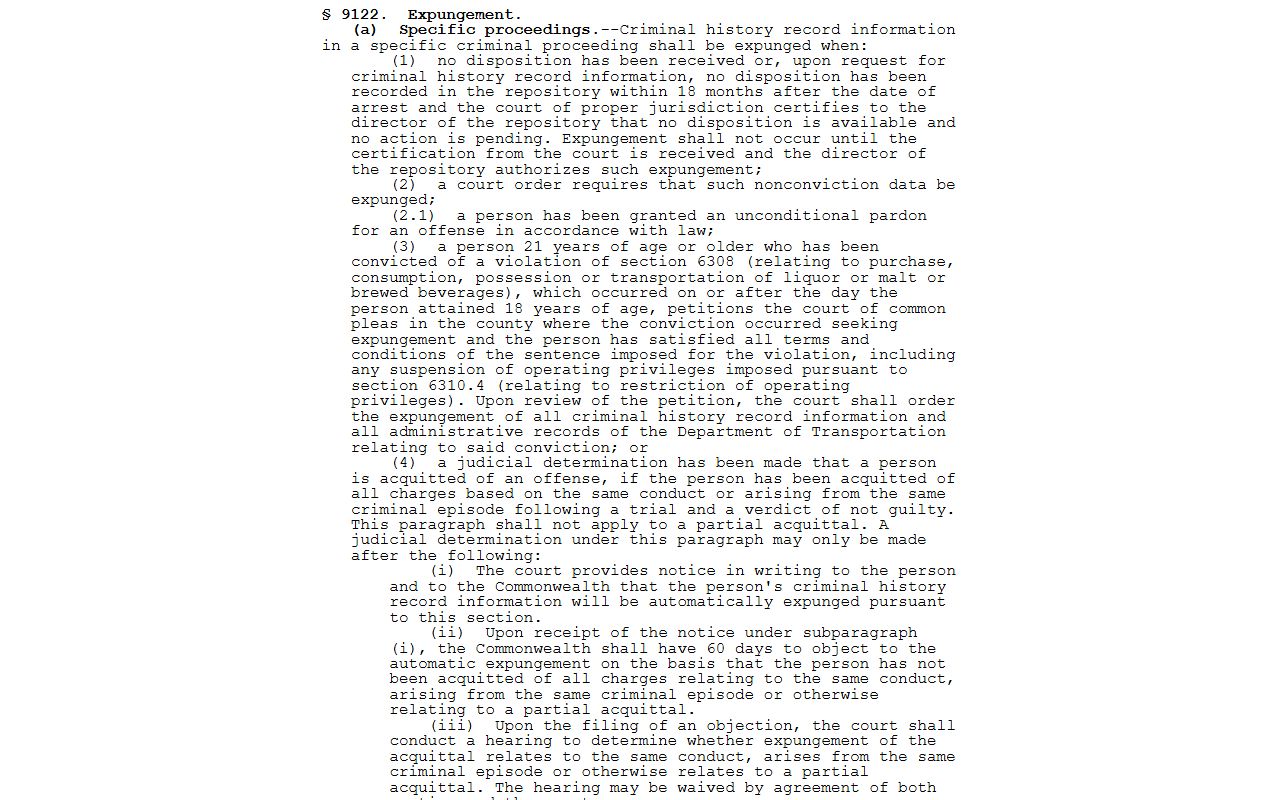
Pennsylvania has two main ways to limit public access to a criminal record. Expungement removes or destroys the record under 18 Pa.C.S. § 9122. Limited access seals an eligible record from public view under 18 Pa.C.S. § 9122.1. They are different tools with different results.
The expungement statute sets the rules for clearing eligible records.
Limited access, by contrast, keeps an eligible record but hides it from ordinary public searches.
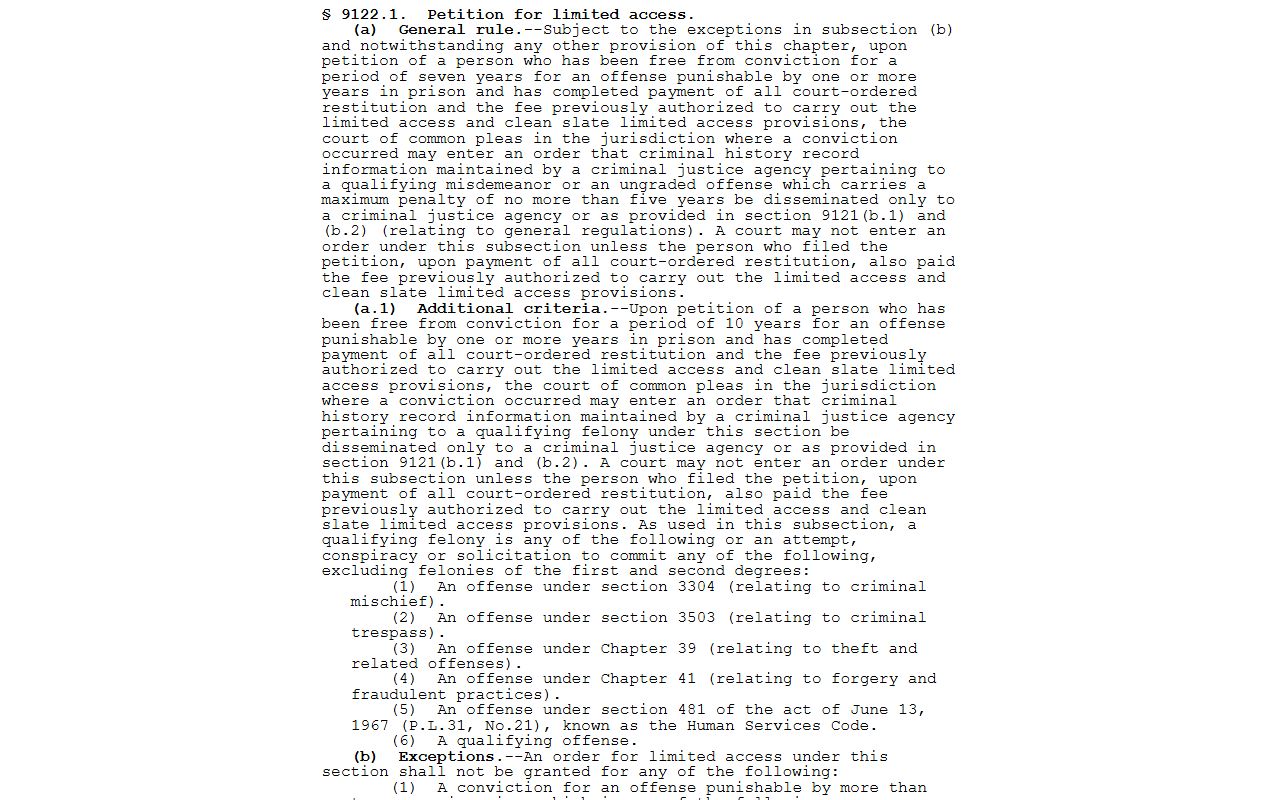
| Sealed (Limited Access) | Expunged | |
|---|---|---|
| Record still exists | Yes, hidden from public | No, removed or destroyed |
| Statute | 18 Pa.C.S. § 9122.1 | 18 Pa.C.S. § 9122 |
| Filed through | Clerk of Courts petition | Clerk of Courts petition |
The Clerk of Courts lists ARD expungement, Rule 490 and 790 petitions, and limited-access forms. See the Erie County Clerk of Courts page for the forms and process.
Juvenile Records Are Restricted
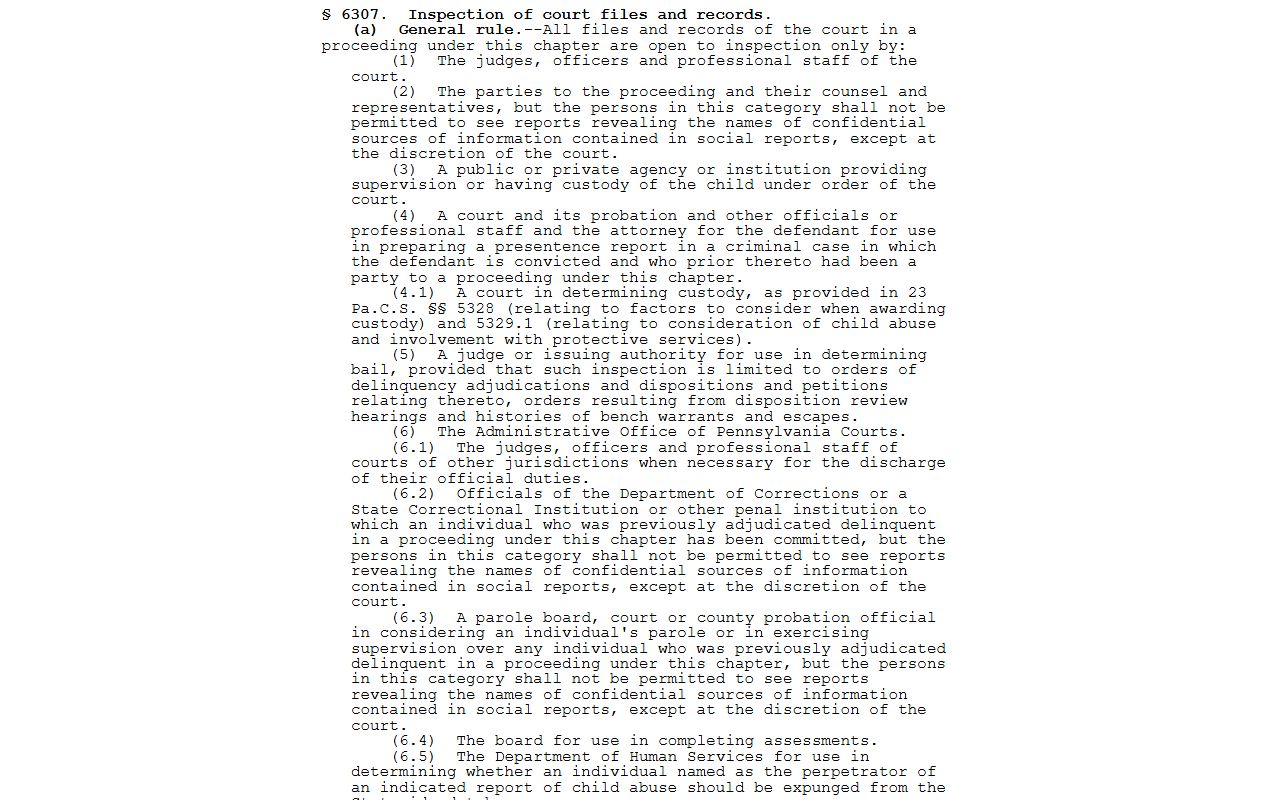
Juvenile records do not behave like adult arrest records. Juvenile court files are restricted under 42 Pa.C.S. § 6307, with access limited to specific people. Juvenile law-enforcement records are restricted under 42 Pa.C.S. § 6308.
The juvenile court-file statute limits who may inspect these records.
The law-enforcement record statute adds a second layer of protection for records about children.
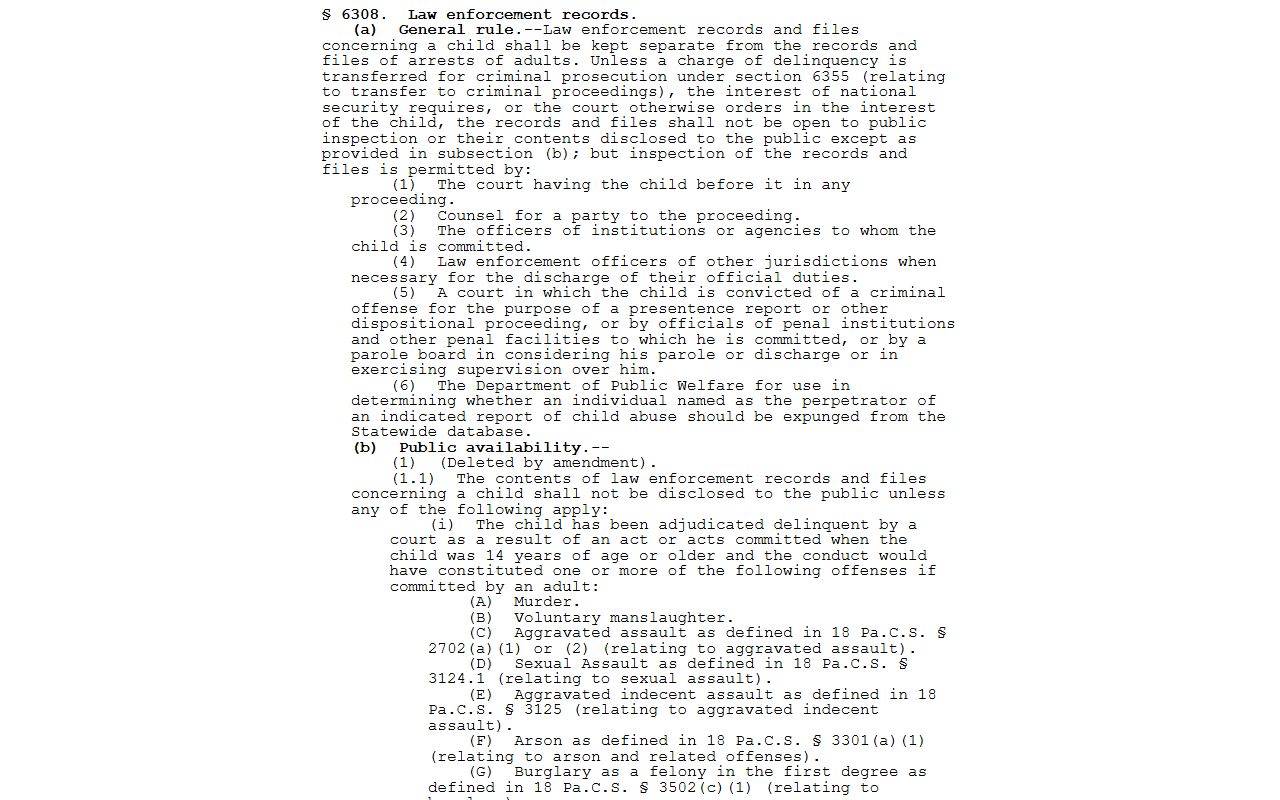
That is why a juvenile matter may not appear in a public search even when an adult name search returns other cases.
Bail and Bond in Erie County Criminal Cases
Bail lets a defendant stay out of custody while a case moves forward. In Erie County, the Clerk of Courts accepts bail bonds to release defendants in Court of Common Pleas criminal cases. The published cost is the bond amount plus a $16.50 filing fee. For the current bond amount and policy on a person already in custody, the Erie County Prison information line at 814-451-7500 is the official source.
Appeals carry their own fees through the same office. A summary appeal from a magisterial decision, including a traffic conviction, costs a $43.50 non-refundable fee. A direct appeal from Common Pleas to the Superior Court runs $43.50 at the Clerk of Courts plus a $91.25 Superior Court fee, which the county notes require separate payment. These fees appear on the Clerk of Courts page, which is the criminal record custodian.
| Action | Fee |
|---|---|
| Bail bond filing | $16.50 plus the bond amount |
| Adult criminal record search | $10 |
| Summary appeal from an MDJ decision | $43.50 non-refundable |
| Direct appeal to Superior Court | $43.50 plus $91.25 Superior Court fee |
Erie County Expungement and Limited Access Process
Clearing or sealing a record runs through the criminal court, not a simple counter request. The Erie County Clerk of Courts lists the forms a person would file: expungement instructions and order, ARD expungement, petitions under Pa.R.Crim.P. 490 and 790, limited access petition, instructions, and order, and the Pennsylvania State Police Access and Review background check. Each form matches a specific legal path.
Eligibility depends on the exact outcome of the case. Nonconviction records, no-disposition records after a statutory period, certain summary cases, acquittals, pardons, and some ARD dispositions may qualify for relief. A petition can be denied when a waiting period is not met, when fines and costs remain unpaid, when the offense is excluded, or when the Commonwealth objects. If a court grants the order, it is sent to the state central repository and criminal justice agencies, and public dockets and background checks should stop showing the cleared record except where the statute still allows it.
If You Find an Active Case
An open charge can mean a court date, a bail condition, or a warrant. If you or someone you know faces active charges and cannot afford a lawyer, the Erie County Public Defender represents qualified people at no charge. Eligibility runs on federal poverty guidelines, and applications are taken weekdays.
The Public Defender's office is at 210 E. Second St., Erie, PA 16507, and it takes applications weekdays from 8:00 a.m. to 4:00 p.m. or by mail. It covers felony and misdemeanor charges, certain incarcerable summary offenses, contempt, probation and parole revocations, and commitment proceedings. Bring or send copies of the charges and income verification, since mailed originals are not returned.
To check warrant status and avoid scam calls, see Erie County warrant records. For custody and bond questions, see inmate records.