
Orphans' Court and Probate in Erie County
Probate is the legal process of settling a person's estate after death, and in Pennsylvania it is Orphans' Court work. There is no separate court called a "probate court" here. Instead, the Orphans' Court Division of the Court of Common Pleas hears estate, guardianship, trust, and fiduciary matters, while the Register of Wills handles the day-to-day work of opening estates and keeping probate filings. The Clerk of Orphans' Court keeps the Orphans' Court record.
This split confuses people who expect a single probate office. In Erie County, both functions sit under the elected Clerk of Records umbrella. The Register of Wills issues the letters that let a personal representative act, and the Orphans' Court resolves disputes and approves accountings. Knowing the two roles makes a probate search far easier, because each holds a different part of the record.
Probate matters because it controls how a person's property passes after death. When there is a will, the named executor asks the Register of Wills to admit it and issue letters testamentary. When there is no will, the estate is intestate, and the office issues letters of administration to a qualified person instead. From there, the personal representative gathers assets, pays debts and taxes, and distributes what remains. Guardianship and trust matters follow their own track through the Orphans' Court, which is why the division handles far more than wills alone.
The Erie County Register of Wills
The Register of Wills is the office that opens estates. It accepts the original will, issues letters testamentary or letters of administration, and keeps the probate file. The office is in Room 122 at the courthouse. The contact block below is the official source for estate filings.
Erie County Register of Wills
140 West Sixth Street, Room 122
Erie, PA 16501
814-451-6260
Probate records from 1823 to present
The county describes the office and its estate role on its official page.
You can review the Erie County Register of Wills page for estate-opening requirements and contact details.
Calling ahead is wise, since the office can explain exactly what documents an estate needs before you arrive.
The Clerk of Orphans' Court
The Clerk of Orphans' Court keeps the records of the Orphans' Court Division. That includes guardianship, fiduciary, and contested estate matters that go beyond the basic opening of an estate. The office works alongside the Register of Wills and shares the Clerk of Records structure.
The county maintains a dedicated page for this office.
You can review the Erie County Clerk of Orphans' Court page for the records it keeps.
For estate-opening, start with the Register of Wills; for guardianship and contested matters, the Orphans' Court is the right track. Guardianship cases, in particular, can involve sensitive medical and financial details, so parts of those files may be restricted or redacted even though probate records are generally open to the public.
Erie County Probate Record Dates
Erie County probate records date from 1823 to the present, according to the county Record Information page. That long span makes the county a strong resource for estate research and family history. The public may search records in the office directly, with no charge for a self-search. If staff conduct the search, the Clerk of Records charges a $20 search fee.
| Service | Fee or Detail |
|---|---|
| Probate record coverage | 1823 to present |
| Search office records yourself | Free |
| Staff-conducted record search | $20 |
| Register of Wills filing fees | From the office fee schedule |
Note: Exact Register of Wills filing and certified-copy fees come from the office's own schedule, so confirm amounts with Room 122 before filing.
Orphans' Court Jurisdiction
Orphans' Court jurisdiction is set by statute. Under 20 Pa.C.S. § 711, the Orphans' Court Division has mandatory jurisdiction over decedents' estates, minors' estates, incapacitated persons' estates, fiduciaries, trusts, guardianships, and related matters. That is why probate, guardianship, and trust disputes all route to the same division.
The statute that grants Orphans' Court its mandatory jurisdiction is published in the Pennsylvania code.
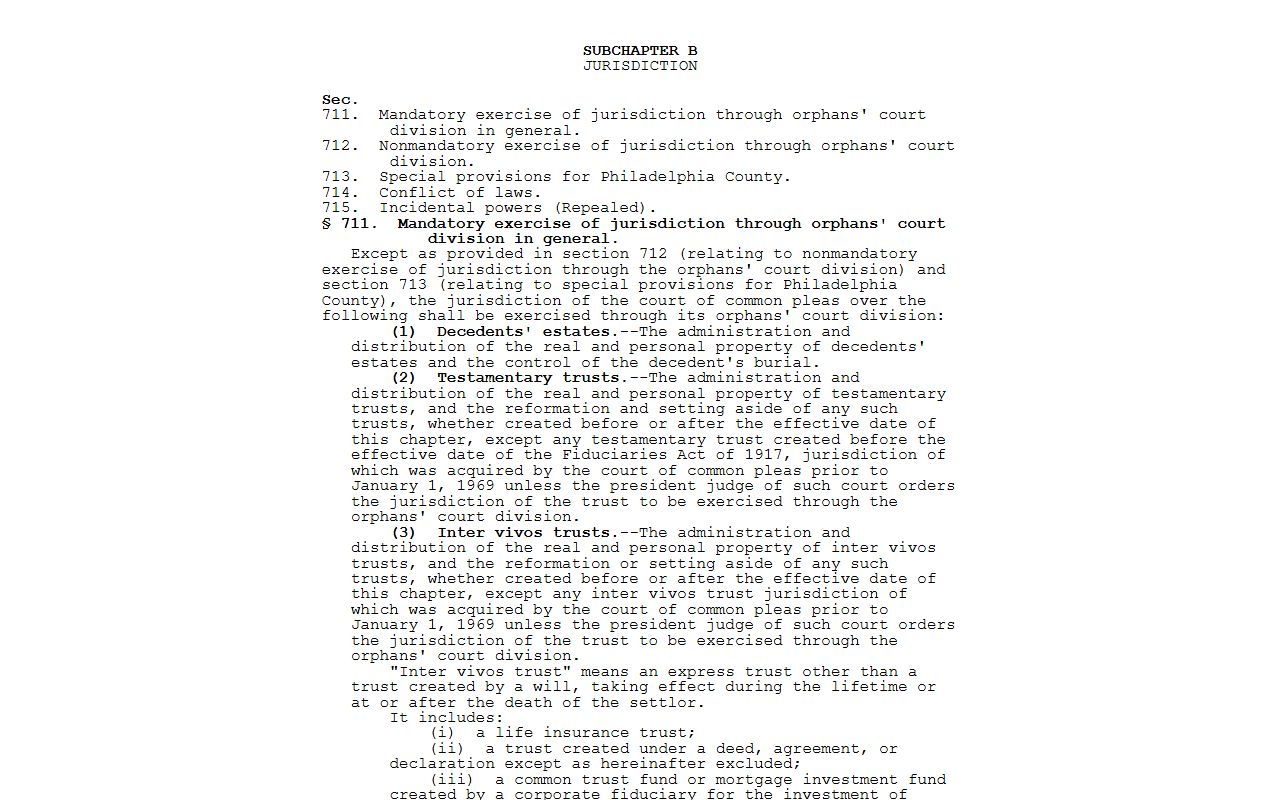
Because the jurisdiction is mandatory, these matters cannot be filed elsewhere, which keeps Erie County probate records centralized in the Orphans' Court and Register of Wills.
What Erie County Probate Records Cover
Probate records cover the documents created when an estate is settled or a guardianship is established. The list below shows the main record types held through the Register of Wills and Orphans' Court.
- Wills and codicils.
- Estate administration, with letters testamentary or letters of administration.
- Small estate petitions or settlement.
- Guardianship of incapacitated adults and minors' estates.
- Trust and fiduciary accountings.
- Inheritance-tax-related estate filings.
- Claims, objections, petitions, and final accounts.
How Probate Works in Erie County
Opening and settling an estate follows a clear sequence. The exact requirements depend on whether the person left a will and on the size of the estate.
- Determine whether the decedent left a will.
- Contact the Register of Wills in Room 122 for estate-opening requirements.
- File the original will if one exists, plus the petition, death certificate, and fee.
- The Register of Wills issues letters if the requirements are met.
- The personal representative gives notices, inventories assets, and handles claims and taxes.
- Contested estates, guardianships, or trust disputes proceed before the Orphans' Court.
- Request certified copies and record searches through the Register of Wills or Clerk of Records.
Probate Terms Defined
Probate uses specific legal terms. A short glossary makes the records easier to read and the process easier to follow.
- Testator
- A person who makes a will.
- Executor
- The person named in a will to settle the estate.
- Intestate
- Dying without a valid will.
- Guardianship
- Court authority to act for an incapacitated adult or a minor.
- Conservatorship
- Management of the property or finances of a person who cannot manage their own.
Small Estates
Not every estate needs full administration. Pennsylvania allows the payment or delivery of certain estate assets without formal administration under 20 Pa.C.S. § 3101, the small-estate statute. This can simplify settling a modest estate, subject to statutory thresholds and procedures.
The Register of Wills can explain whether a particular estate qualifies for a small-estate process and what documents are required. Because thresholds and rules change, confirm the current procedure with the office rather than relying on an old figure. A small-estate path can save time and cost when an estate is modest and uncontested, but it is not available for every estate.
Adoption Records Are Restricted
Adoption records are among the clearest nonpublic categories in Pennsylvania. Under 23 Pa.C.S. § 2905, adoption documents are kept as a permanent record but withheld from inspection except by court order for cause shown. They should not be treated as ordinary public probate or family records.
The adoption-record statute spells out the impoundment and access rules.
Probate records are generally public, but guardianship, incapacity, minors' estate, medical, and financial details can be restricted or redacted, so not every Orphans' Court record is fully open.
How to Search Erie County Probate Records
Probate record access in Erie County is mostly local. The county invites the public to search records in the office directly, and a full online probate search form was not found in the reviewed county pages. The statewide portal does list an Orphans' Court docket type, but estate record access is primarily handled at the county level through the Register of Wills and Clerk of Orphans' Court. For older estate files, calling Room 122 to ask what can be searched remotely versus in person is the most reliable first step.
| Method | Type | Notes |
|---|---|---|
| In-office probate search | Self-search | The public may search office records directly |
| Staff-conducted search | Service request | $20 search fee through the Clerk of Records |
| UJS Orphans' Court docket type | Statewide portal | Limited; estate access is primarily local |
Genealogy and estate researchers often value the depth of these records, since probate files reach back to 1823. That is far older than the county's marriage records, which start in 1885, and it makes Orphans' Court a useful stop for tracing family property and estate history. For the document itself, a certified copy comes from the Register of Wills.