
About the Erie County Clerk of Courts
Pennsylvania splits its court-record duties, and the Clerk of Courts is the criminal half in Erie County. While the Prothonotary keeps civil files, the Clerk of Courts is the custodian for all criminal court records. The office sits in Room 103 of the courthouse and operates under the elected Clerk of Records. It is the place to go for a certified criminal record, a bail bond, or a criminal appeal.
Erie County Clerk of Courts
140 West Sixth Street, Room 103
Erie, PA 16501
814-451-6221
Criminal record custodian
The county describes the office's criminal record role on its official page.
You can review the Erie County Clerk of Courts page for criminal record duties and fees.
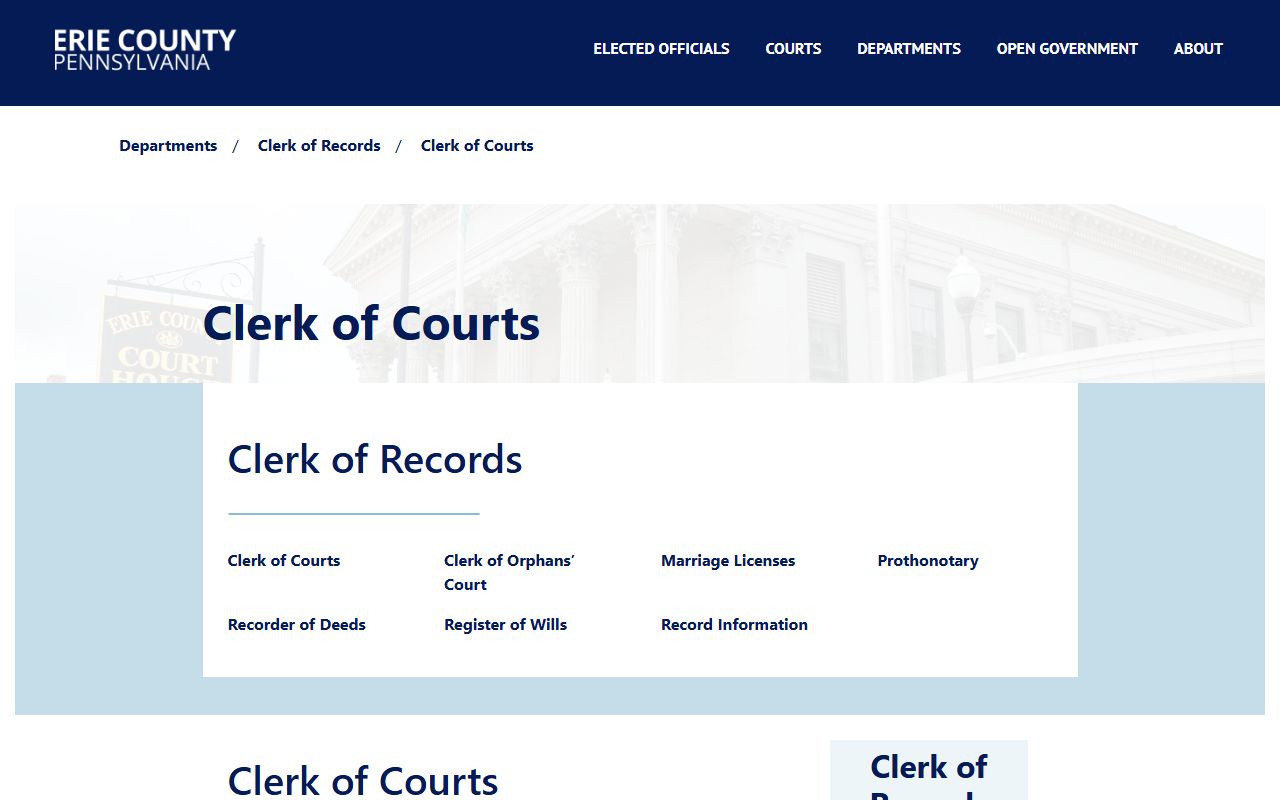
That page is the official source for the office's criminal search, bail, and appeal functions.
What the Clerk of Courts Holds
The Clerk of Courts is the criminal court record custodian. The county describes the criminal file as the motions, pleadings, transcripts, and other filings tied to a criminal case. The office also handles a few non-criminal dockets, though the county notes those are a small share of its work.
- Criminal motions, pleadings, and transcripts.
- Bail bond filings for Court of Common Pleas cases.
- Summary appeals from magisterial district decisions.
- Direct appeals from Common Pleas to the Superior Court.
- Road dockets, liquor board matters, and miscellaneous dockets.
Civil, divorce, custody, and lien records are not here; those belong to the Prothonotary. Keeping the two offices straight is the key to a fast records search, because the wrong counter cannot pull the file you need.
A criminal case often begins at a magisterial district court with a complaint, a preliminary arraignment, and a preliminary hearing. If the case is held for court, it moves up to the Court of Common Pleas, and that is where the Clerk of Courts takes over as the record custodian. From that point, the office holds the charging information, the motions, the plea or trial record, the sentence, and any appeal. That makes it the central office for a certified Erie County criminal court record.
Adult Criminal Record Searches
The Clerk of Courts performs adult criminal record searches for a $10 fee. This is a local court-record search, not a statewide background check. A statewide criminal history comes from the Pennsylvania State Police PATCH service instead, and the public docket portal is a third, separate tool. Each draws from a different system, so the right choice depends on what the record is for.
For a public docket of a criminal case, the statewide UJS portal lists Common Pleas criminal dockets by name, OTN, or docket number. The Clerk of Courts is the source for a certified local criminal record or an older file. For the broader explanation of these record types, see Erie County arrest records.
Bail Bonds and Appeal Fees
The Clerk of Courts accepts bail bonds to release defendants in Common Pleas criminal cases. It also processes appeals, each with its own fee. The table below lists the office's published fees.
| Service | Fee |
|---|---|
| Bail bond filing | $16.50 plus the bond amount |
| Adult criminal record search | $10 |
| Summary appeal from an MDJ decision | $43.50 non-refundable |
| Direct appeal to Superior Court | $43.50 plus $91.25 Superior Court fee |
The direct appeal fees require separate payment, one to the Clerk of Courts and one to the Superior Court, so plan for two checks or money orders. For current bond amounts on someone in custody, the Erie County Prison line at 814-451-7500 is the source; see inmate records.
Summary and Direct Appeals
Appeals run through this office on the criminal side. A summary appeal challenges a magisterial district judge's decision on a summary matter, including a traffic code violation, and carries the $43.50 non-refundable fee. A direct appeal moves a Common Pleas decision up to the Superior Court of Pennsylvania, which hears most criminal and civil appeals from the county.
Appeals are deadline-driven, so timing matters. The Clerk of Courts provides summary appeal forms and information, and the office can explain where to file. For the court structure behind these appeals, see the Court of Common Pleas.
Expungement and Limited Access Forms
Clearing or sealing a criminal record runs through this office. The Clerk of Courts lists the forms a person would file, each tied to a specific legal path. Using the right form for the case outcome matters, because the rules differ.
- Expungement instructions, order, and ARD expungement.
- Petitions under Pa.R.Crim.P. 490 and 790.
- Limited access petition, instructions, and order.
- Pennsylvania State Police Access and Review background check.
- Pardon project information and intake form.
The office disclaims that forms are legal advice and recommends consulting an attorney to be sure a form fits the case. The Clerk of Courts also lists pardon project information and an intake form, since a pardon is a separate path that can affect later expungement eligibility. For how expungement and limited access differ, see arrest records.
How to Request a Certified Criminal Copy
A certified copy carries the court's seal and is the version accepted for legal use. The steps below outline how to get a certified criminal record from the Clerk of Courts.
- Identify the case by docket number, OTN, or defendant name.
- Confirm the exact document you need from the criminal file.
- Contact the Clerk of Courts in Room 103 or submit a request as directed.
- Pay the applicable fee, such as the $10 record search where it applies.
- Pick up the certified copy or receive it by the arranged method.
The Public Defender for Criminal Cases
People who discover an active criminal case may need a lawyer they cannot afford. The Erie County Public Defender represents financially qualified people whose liberty is at stake. Eligibility runs on federal poverty guidelines, and there is no charge for representation or for filing fees in the case once a person qualifies.
The office handles felonies, misdemeanors, certain incarcerable summary offenses, contempt, probation and parole revocations, and commitment proceedings.
You can review the Erie County Public Defender page for eligibility and how to apply.
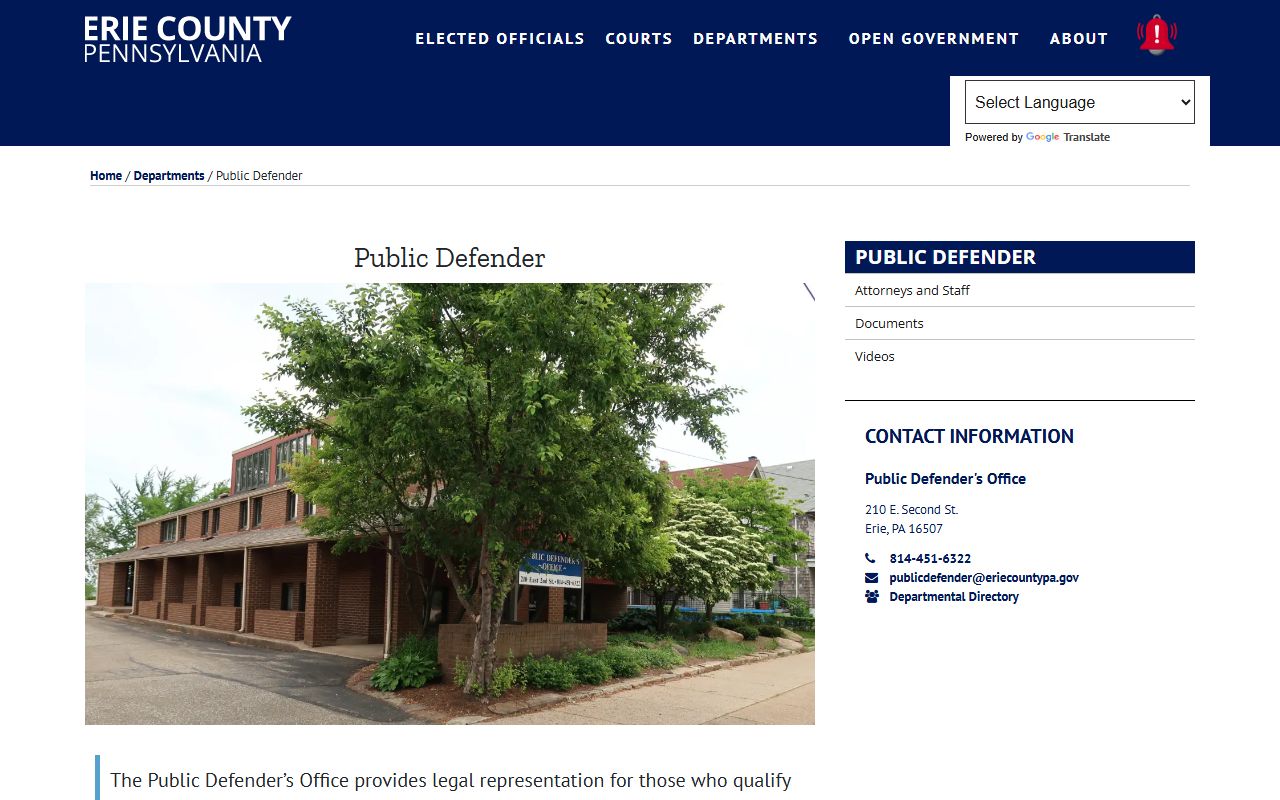
The office is at 210 E. Second St., Erie, PA 16507, and takes applications weekdays from 8:00 a.m. to 4:00 p.m. or by mail. Bring or send copies of the charges and income verification.
How to Search Erie County Criminal Records
There are three main ways to look up an Erie County criminal record, and they are not interchangeable. The statewide UJS portal lists public criminal dockets by name, OTN, or docket number. The Clerk of Courts runs a local adult criminal record search for $10 and holds the certified criminal file. The Pennsylvania State Police PATCH service produces a statewide criminal-history report, which is a different product altogether.
Pick the tool by purpose. To follow a case and read its events, the public docket portal works and is free. To get a certified local record or an older criminal file, the Clerk of Courts is the source. For an employment or licensing background check, PATCH is the official statewide route. Mixing them up is the most common reason people end up at the wrong counter or pay for a report they did not need. For a fuller breakdown of these record types, see arrest records.
What Criminal Records Do Not Show
Not every criminal matter appears in a public search. Juvenile cases are restricted by law, so they do not behave like adult dockets. Expunged records are removed, and limited-access cases are sealed from public view, which means a name that returns nothing in one tool may still have records elsewhere. The public access policy also keeps certain confidential information out of the open record.
This is why a blank result is not proof that no case exists. Wrong spelling, the wrong court, a sealed or limited-access status, or a juvenile category can all hide a record. When a search comes up empty and you still have reason to check, the Clerk of Courts can confirm whether a public criminal record exists and how to obtain a certified copy. For sealing and clearing eligibility, the expungement and limited-access forms above are the proper path.