
How Erie County Marriage and Divorce Records Are Split
Pennsylvania keeps marriage records at the county level, so there is no single statewide public marriage search that replaces the county office. In Erie County, the Marriage Bureau under the Clerk of Records issues licenses and provides certified marriage records. Divorce is a court matter, filed in the Court of Common Pleas and held by the Prothonotary on the civil side. Knowing this split is the first step, because a person looking for a marriage certificate and a person looking for a divorce decree go to different rooms in the courthouse.
Both kinds of records can be searched in person at the courthouse, and the county allows the public to search office records directly. If staff conduct the search instead, the Clerk of Records charges a $20 search fee. For the broader civil record system behind divorce files, see Erie County court records.
The Marriage Bureau sits under the elected Clerk of Records, the same umbrella office that oversees the Prothonotary, the Clerk of Courts, the Register of Wills, and the Clerk of Orphans' Court. That structure is why marriage and probate functions share record-information staff while divorce stays on the civil court side. For a person who knows only that they need a "court record," the practical question is which office holds the file, and for marriage and divorce that answer points to two different counters.
The Erie County Marriage Bureau
Marriage records and licenses are handled at the courthouse in Room 123. The office issues new licenses and provides certified copies of marriage records on file. The contact block below is the official source for marriage matters.
Erie County Marriage Bureau / Clerk of Records
140 West Sixth Street, Room 123
Erie, PA 16501
814-451-6264
Marriage records from 1885 to present
The county describes the marriage license process and fees on its official page.
You can review the Erie County marriage licenses page for the current process and contact details.
That page is the right starting point before applying, since the bureau confirms current requirements and hours.
Marriage Record Dates and Fees
Erie County marriage records date from 1885 to the present, according to the county Record Information page. Certified copies and replacements carry set fees, listed below. A self-search in the office is free, while a staff-conducted search runs $20.
| Service | Fee |
|---|---|
| Certified marriage record | $5 |
| Replace lost or destroyed marriage license | $10 |
| Staff-conducted record search | $20 |
| Search office records yourself | Free |
Note: Pennsylvania marriage records are county records, so a certified Erie County marriage copy comes from the county bureau rather than a single state database.
Older Marriage Records and Other Vital Records
Erie County's marriage records run from 1885 to the present, which makes the county office a useful stop for genealogy and older family research. The county also held early birth and death records for a limited window. According to the county Record Information page, city births appear from 1888 to 1905, county births from 1893 to 1905, city deaths from 1894 to 1905, and county deaths from 1893 to 1905. Those date ranges are narrow on purpose.
Modern birth and death records are not county records in Pennsylvania. From 1906 forward, the state handles them through the Pennsylvania Bureau of Vital Statistics, not the county courthouse. So a person seeking a recent birth or death certificate goes to the state, while a person seeking a marriage record or an older pre-1906 vital record may find it at the county. Sorting out which office holds which record by date saves a wasted trip.
Pennsylvania Marriage License Waiting Period
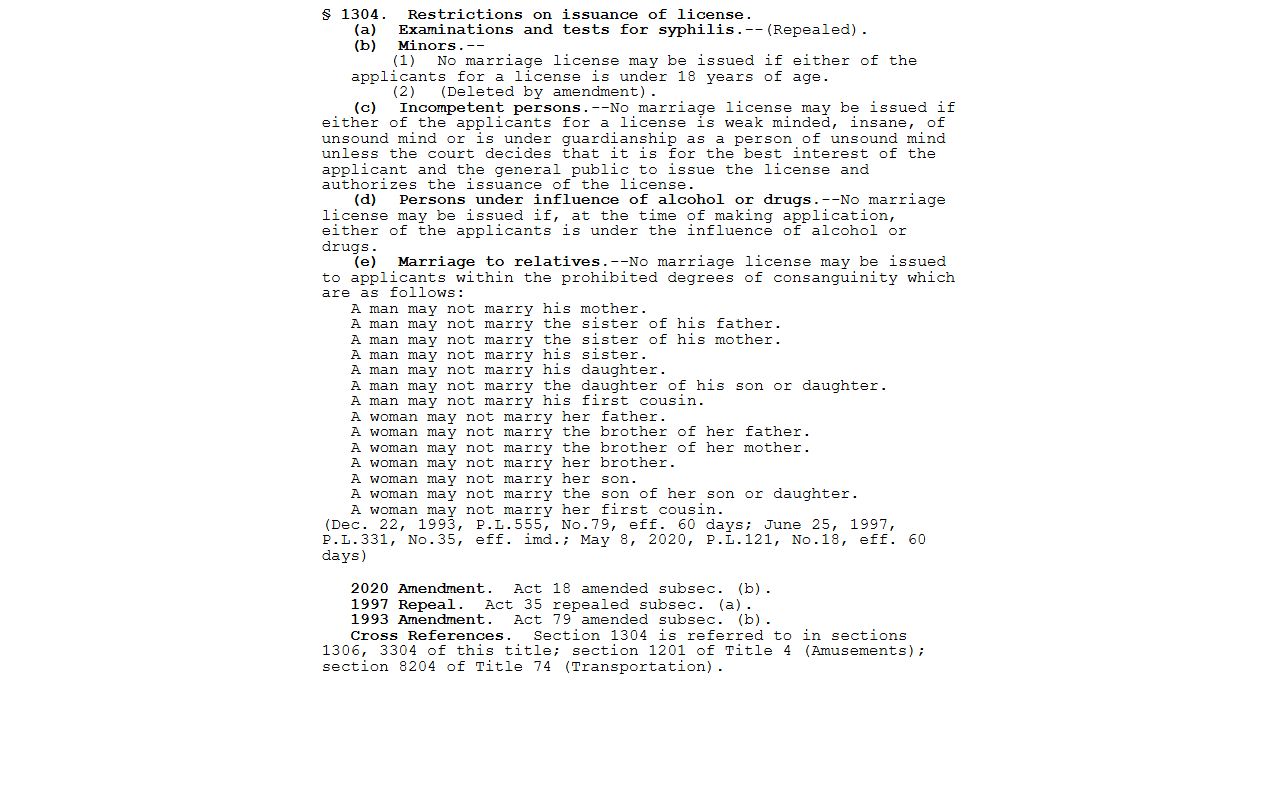
Pennsylvania law sets a three-day waiting period after a marriage-license application before the license can be used, with limited statutory exceptions. The rule comes from 23 Pa.C.S. § 1304, which also covers restrictions on issuance. A judge can waive the waiting period in some cases.
The statute behind the waiting period and license restrictions is published in the Pennsylvania code.
Pennsylvania also recognizes self-uniting marriage licenses, so couples should confirm the local process with the Marriage Bureau before applying.
How to Apply for a Marriage License
Applying for a marriage license in Erie County follows a clear set of steps. Both applicants generally appear, provide identification, and complete the application before the waiting period starts.
- Contact the Marriage Bureau in Room 123 or call 814-451-6264.
- Complete the application and provide required identification.
- Provide prior-marriage documentation, such as a divorce or death record, if it applies.
- Pay the county license fee.
- Wait the statutory three days unless a judge grants a waiver.
- Have the ceremony performed, or use a self-uniting license if obtained.
- Return the license for recording, then request a certified copy if needed.
Marriage License Application Fields
The exact live form fields are confirmed at the bureau, but Pennsylvania county marriage applications typically ask for a standard set of details. The table below lists the fields a couple should expect to provide.
| Field | What It Asks |
|---|---|
| Legal names | Full legal name of each applicant |
| Address and contact | Current address and contact information |
| Date and place of birth | Birth date and birthplace |
| Parent names | Names of each applicant's parents |
| Prior marriage status | Divorce or death dates if applicable |
| Identification | Government ID and statement of identity |
| Oath and signatures | Sworn statement and signatures |
Confirm the current required documents with the Marriage Bureau, since requirements can change. Bringing the right identification and any prior-marriage paperwork on the first visit avoids a second trip and keeps the three-day waiting period from starting over.
Divorce Records Through the Prothonotary
Divorce is a civil court matter, not a vital record. In Erie County, divorce cases are filed with the Prothonotary in Room 120 and held in the Court of Common Pleas family and civil division. Divorces are explicitly listed among the records the Prothonotary keeps, alongside custody, Protection From Abuse cases, judgments, and liens. A Divorce Information Sheet appears on the office's form list.
To search divorce records, use the county CourtPro public access system or the Prothonotary office. A staff-conducted Clerk of Records search costs $20, while a self-search is free. A Pennsylvania divorce file can include the complaint, notice to defend, affidavits or consents, a property settlement agreement, custody and support filings, and the final decree. For the civil search tools, see the Erie County Prothonotary page.
One Erie-specific point matters for divorce searches. The county moved its civil records to CourtPro in April 2024, and the older INFOCON system stopped taking new filings after that. If an older divorce file does not turn up in a prior search method, that is often the system change at work, not a missing case. Check CourtPro or call the Prothonotary in Room 120 at 814-451-6250 before concluding the record is gone. Self-represented filers can also use the office's Divorce Information Sheet and the Petition for Leave to Proceed in forma pauperis if they cannot afford the fees.
How to File for Divorce in Erie County
Filing for divorce follows the civil court process. The steps below outline the path, though the specific grounds and timing depend on Pennsylvania divorce law.
- Confirm Erie County jurisdiction and Pennsylvania residency under the divorce code.
- Obtain the state and county divorce forms and the Prothonotary filing requirements.
- File the complaint and required cover and information sheets with the Prothonotary.
- Serve the other spouse as required.
- Follow the applicable no-fault consent, separation, or fault procedures.
- Use a fee waiver petition if you cannot afford the filing fees.
- Request a certified divorce decree from the Prothonotary after the final decree.
Confidential Family Information
Not everything in a family case is public. A divorce decree may be obtainable, but custody details, financial account numbers, minors' information, and abuse-victim contact information are protected under the court's public access policy. Some items must be filed through confidential information procedures rather than placed in the open record.
This protection is part of the broader Pennsylvania case-record access framework. For how those rules apply across court records, see Erie County public records, and note that CourtPro currently does not accept Family Court e-filings, so confirm filing methods with the Prothonotary.