
Court Records vs Right-to-Know in Erie County
Pennsylvania does not use one rule for every public record. The Right-to-Know Law covers records that document the business of a government agency. The judiciary, though, has its own authority over court case records, which run through a separate public access policy and the court custodians. So a request for a county contract goes through Right-to-Know, while a request for a court docket goes to the Prothonotary, Clerk of Courts, or the statewide portal.
Mixing the two leads to dead ends. Filing a Right-to-Know request for a docket sheet is the wrong path, because court records are not ordinary agency records. Use Right-to-Know for county administrative records, such as budgets, contracts, policies, meeting records, or jail administrative documents. Use the court access policy and the custodians for case files. For case dockets, see Erie County court records.
Erie County Right-to-Know Requests
The Right-to-Know Law, passed as Act 3 of 2008 and effective in 2009, created a presumption of access for many state and local agency records. Erie County accepts Right-to-Know requests for its agency records through an open-government process. Filing a clear, specific request gets a faster, better answer.
- Identify the exact record you want and the agency that holds it.
- Write a specific request describing the record, not a broad fishing request.
- Submit it through the county's Right-to-Know process.
- Choose your preferred format and delivery, such as copies or electronic files.
- Wait for the agency response within the legal timeline, then appeal if denied.
Court records do not follow this route. The judiciary's policy and custodians handle case files, which is why a docket request goes to a clerk rather than through Right-to-Know.
What a Records Request Should Include
A complete request moves faster because the agency does not have to guess what you mean. The table below shows the information a typical request should carry.
| Field | What to Provide |
|---|---|
| Requester name and contact | How the agency reaches you with the response |
| Record description | A specific description of the record sought |
| Date range | The time period the records cover, if known |
| Format requested | Paper copies or electronic files |
| Delivery method | Pickup, mail, or email |
For court copies, the request goes to the clerk that holds the file rather than on a Right-to-Know form.
The UJS Case Records Public Access Policy
Court records in Pennsylvania follow the Case Records Public Access Policy of the Unified Judicial System, set out in 204 Pa. Code § 213.81. The policy requires court case records to be available to the public, subject to rules on confidential information and confidential documents. Every court and custodian office must keep the policy available, and the state posts it online.
The policy has two practical pieces for self-represented people. Some information can appear in a filing only through a confidential information form or a redacted version. Some whole documents are not public at all. The state keeps its public record policies page as the central reference for these rules.
Statutes and Restrictions
Public access rests on several laws that pull in different directions. The list below names the main ones for Erie County records.
- The Right-to-Know Law, 65 P.S. § 67.101, for county agency records.
- 204 Pa. Code § 213.81, the court case-record access policy.
- 42 Pa.C.S. § 6307, which restricts juvenile court files.
- 23 Pa.C.S. § 2905, which seals adoption records.
Together these explain why a record can be "public" in theory yet restricted, redacted, or available only by office copy in practice.
County Agency Records the Clerk Maintains
Beyond court files, the county and its row offices keep many records people request. The Clerk of Records umbrella oversees the Prothonotary, Clerk of Courts, Register of Wills, Clerk of Orphans' Court, Recorder of Deeds, and Marriage Bureau. Property deeds, business filings, marriage records, and probate records all live in these offices rather than in a single search box.
County administrative records, such as budgets, contracts, and meeting minutes, are the kind handled through Right-to-Know. Knowing which office and which system applies is the key step, since the same word, "records," can point to very different places.
Federal Court Records and PACER
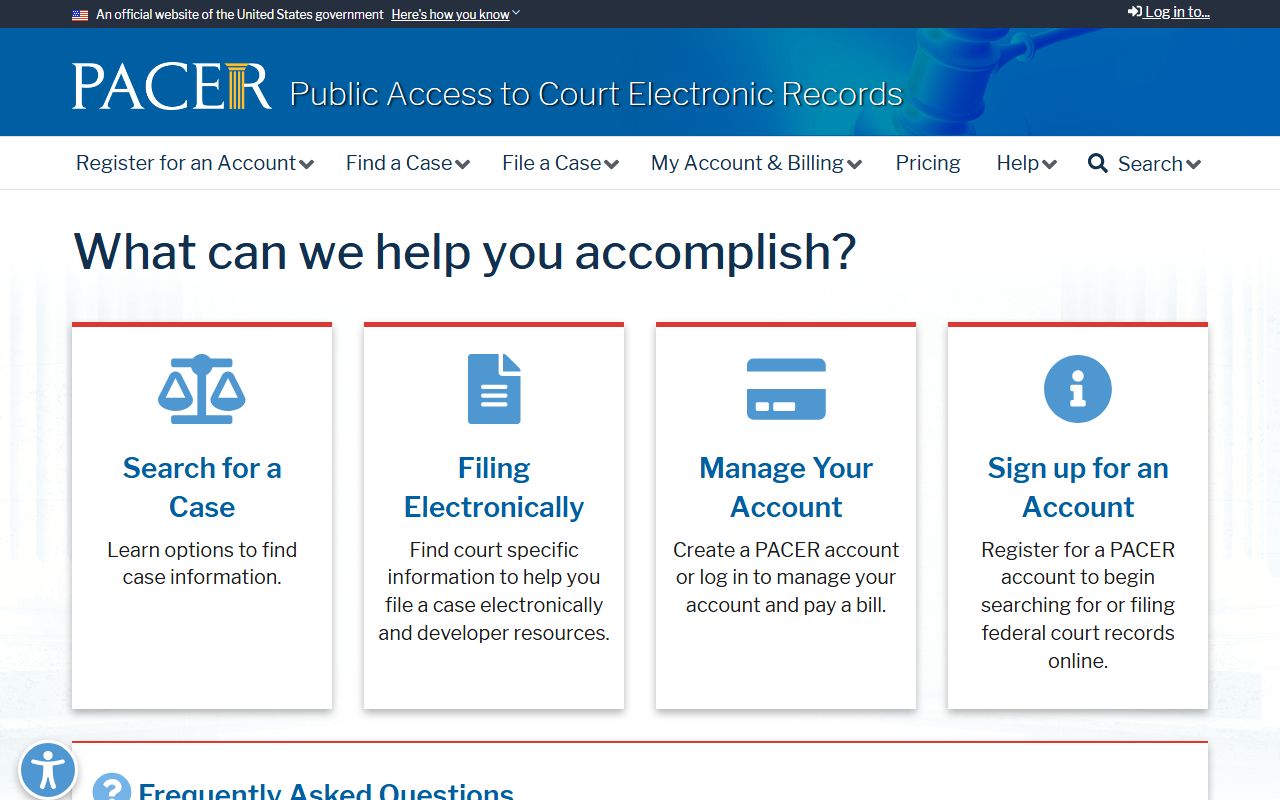
Federal records are separate from county and state records. Erie County sits in the Western District of Pennsylvania, and federal dockets live on PACER, the national federal court records service. PACER covers district, bankruptcy, and appellate courts.
The federal records service is the gateway to district and appellate dockets.
You can reach PACER for federal district, bankruptcy, and appellate court records.
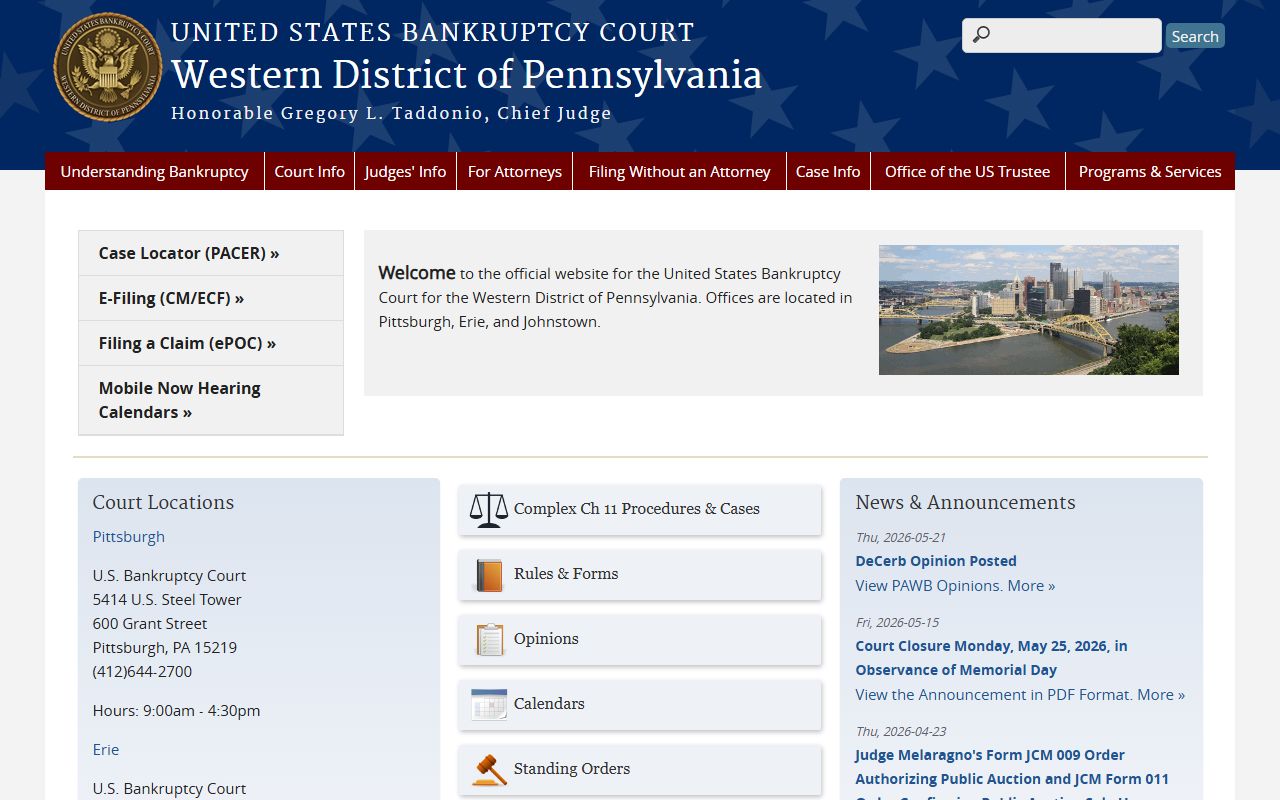
Bankruptcy has its own court and electronic system in the Western District.
The U.S. Bankruptcy Court for the Western District of Pennsylvania handles bankruptcy filings for the Erie area.
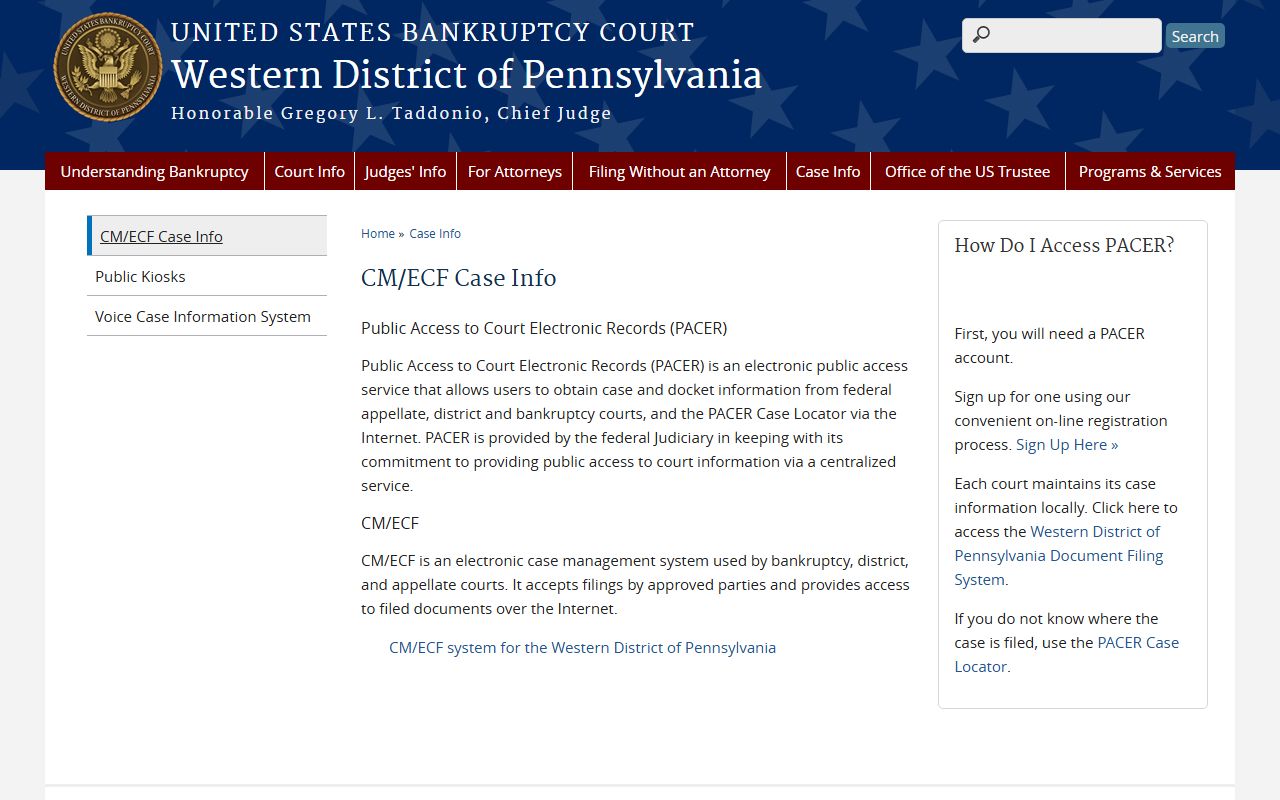
That court explains its electronic case access on a dedicated page.
The bankruptcy PACER and CM/ECF page covers electronic access to case information.
None of these federal records appear on the county or state systems, so use the federal tools for federal matters.
Court Copies and Record Fees
Two phrases matter here. "Public" does not mean "online," and "online docket" does not mean "full file." Many Erie County records are public but only available by in-person search, an office request, or a paid certified copy. Fees come from two systems that should not be mixed. Under Right-to-Know, agencies can charge allowed duplication, certification, and postage fees. Court copy and certification fees come from judicial and county fee schedules instead.
| Service | Fee |
|---|---|
| Search office records yourself | Free |
| Staff-conducted record search (Clerk of Records) | $20 |
| Adult criminal record search (Clerk of Courts) | $10 |
| Certified marriage record | $5 |
Confidential Information and Appeals
Some records are exempt or confidential, and a request can be denied in whole or in part. Body camera footage, police incident reports, jail video, and active investigative records are agency or law-enforcement records where exemptions may apply. For court records, confidential information and confidential documents are protected under the access policy.
Right-to-Know denials are time-sensitive and can be appealed. The Pennsylvania Office of Open Records is the central body for Right-to-Know appeals, forms, and guidance for covered agencies. Court-record access disputes follow a different path, often through the custodian or court rather than the Office of Open Records. Knowing which system your request falls under tells you where to appeal.
When a Record Is Public but Not Online
A common surprise is that a public record may not be available with a click. In Erie County, many records are open to inspection but live only on paper, in an office file, or behind a request and a fee. A statewide docket sheet shows the events of a case, not the underlying documents. A property deed sits with the Recorder of Deeds. A probate file sits with the Register of Wills. The record exists and is public, yet getting a copy still means contacting the right office.
This also explains why a search can return nothing while a record still exists. Wrong spelling, the wrong court, an older local-only file, a sealed or limited-access case, or a confidential category can all hide a record from an online search. When that happens, the office that holds the file is the place to confirm whether the record exists and how to get a copy.
Common Public Records Mistakes
A few mistakes send Erie County requesters in circles. Avoiding them speeds up almost any records search. The list below covers the ones that come up most.
- Filing in the wrong office: criminal records go to the Clerk of Courts, civil and divorce to the Prothonotary, probate and marriage to the Register of Wills and Marriage Bureau.
- Assuming the statewide portal has every civil document, when many Common Pleas civil records are limited online.
- Using a Right-to-Know request to get a court docket, which the judiciary handles separately.
- Relying on a third-party background-check site instead of official court and state police sources.
When in doubt about which office and which system applies, the routing comes down to the record type, and the Erie County Court Records FAQ sorts many of these questions out.