
How to Search Erie County Court Records
Erie County court records live in two main public tracks. Statewide docket sheets for criminal, traffic, and magisterial cases are on the Pennsylvania Unified Judicial System (UJS) portal. Civil cases run through Erie County's own CourtPro system after the county switched over in 2024. You pick the track by record type, not by guesswork.
Before you start, know the basics of the case. A name helps. A docket number or citation number helps more. The Erie County Courts homepage is the hub for office links, judges, and the courthouse address.
The Pennsylvania court system explains its public access tools on the Erie County Courts homepage, which links each record office and the public docket search.
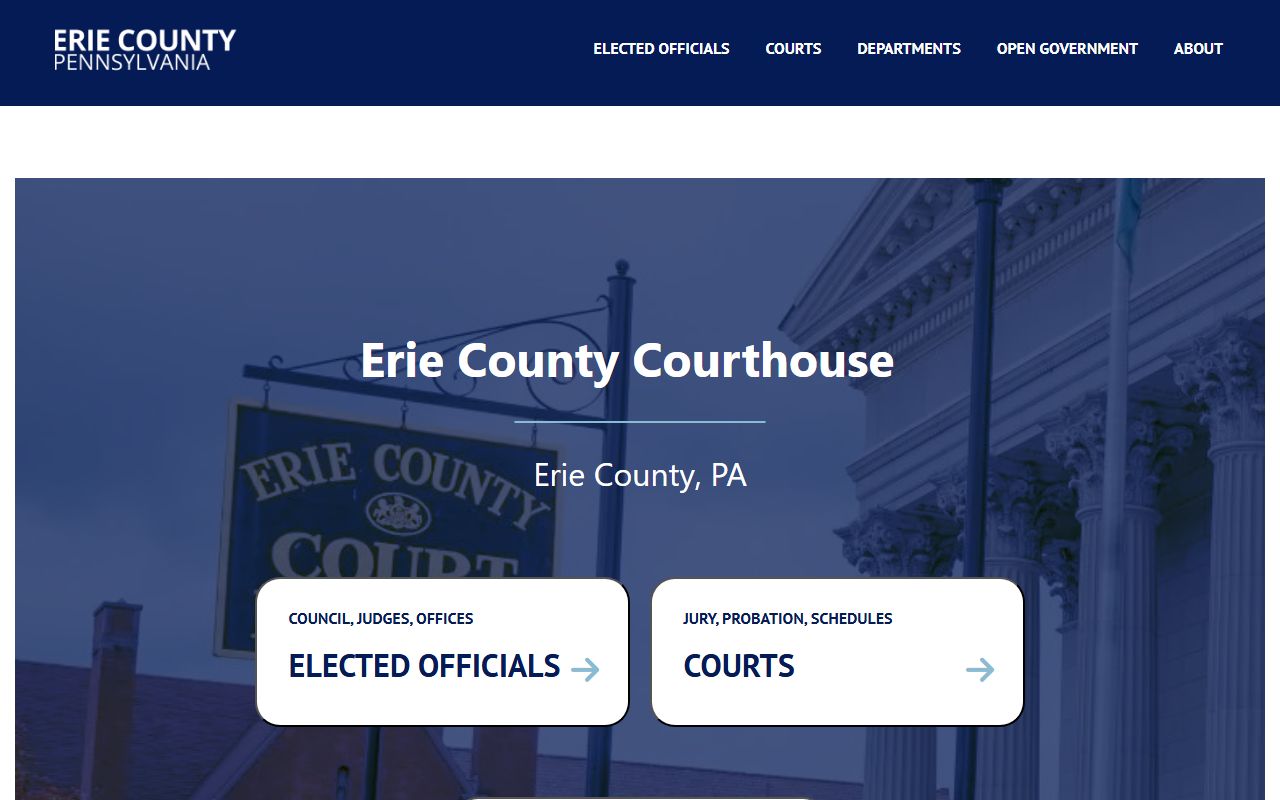
That homepage points civil users to CourtPro and criminal users to the Clerk of Courts, so it is a good first stop before any record search.
- Decide the record type: criminal, civil, family, traffic, or probate.
- For criminal or traffic cases, open UJS Case Search and pick a search mode.
- Enter a docket number, citation number, or participant name, then narrow by "Erie - 06."
- For civil and divorce cases, use Erie County CourtPro or visit the Prothonotary.
- Request a certified copy from the office that holds the file if you need one for court.
A staff-run search at the Clerk of Records office costs $20 if you would rather have staff pull the record. You can also search the office records yourself at no charge.
Erie County Court Records Search Fields
The UJS Case Search portal changes its fields based on the "Search By" mode you pick. Name search is broad. Docket and citation search are exact. The table below lists the most useful fields for an Erie County court records search.
| Field Label | Type | Required | Notes / Format |
|---|---|---|---|
| Search By | Dropdown | Yes | Docket Number, Participant Name, Citation Number, OTN, and more |
| Participant Name | Text | Conditional | Narrow with Erie County and a docket type |
| Docket Number | Text | Conditional | CP for Common Pleas, MJ for magisterial cases |
| Citation Number | Text | Conditional | Enter the dash, such as A5368532-1 |
| County | Dropdown | Conditional | Select Erie |
| Judicial District | Dropdown | Conditional | Select Erie - 06 |
| Date Filed | Date | Conditional | 180-day max range in Date Filed mode |
The portal warns that some cases do not show. Juvenile, expunged, limited-access, and many Common Pleas civil cases may be hidden by law, so a blank result does not always mean no case exists.
The Erie County Judicial System
Pennsylvania runs a unified court system. Erie County is the Sixth Judicial District, and its trial court of general jurisdiction is the Court of Common Pleas. President Judge John J. Mead leads a nine-judge trial court. Below it, magisterial district courts handle the first steps of many cases.
Court Administration runs the daily work of the trial court. Its goal, as the county states it, is fair, impartial, and prompt judicial service across criminal, civil, and family divisions.
You can read about the office on the Erie County Court Administration page.
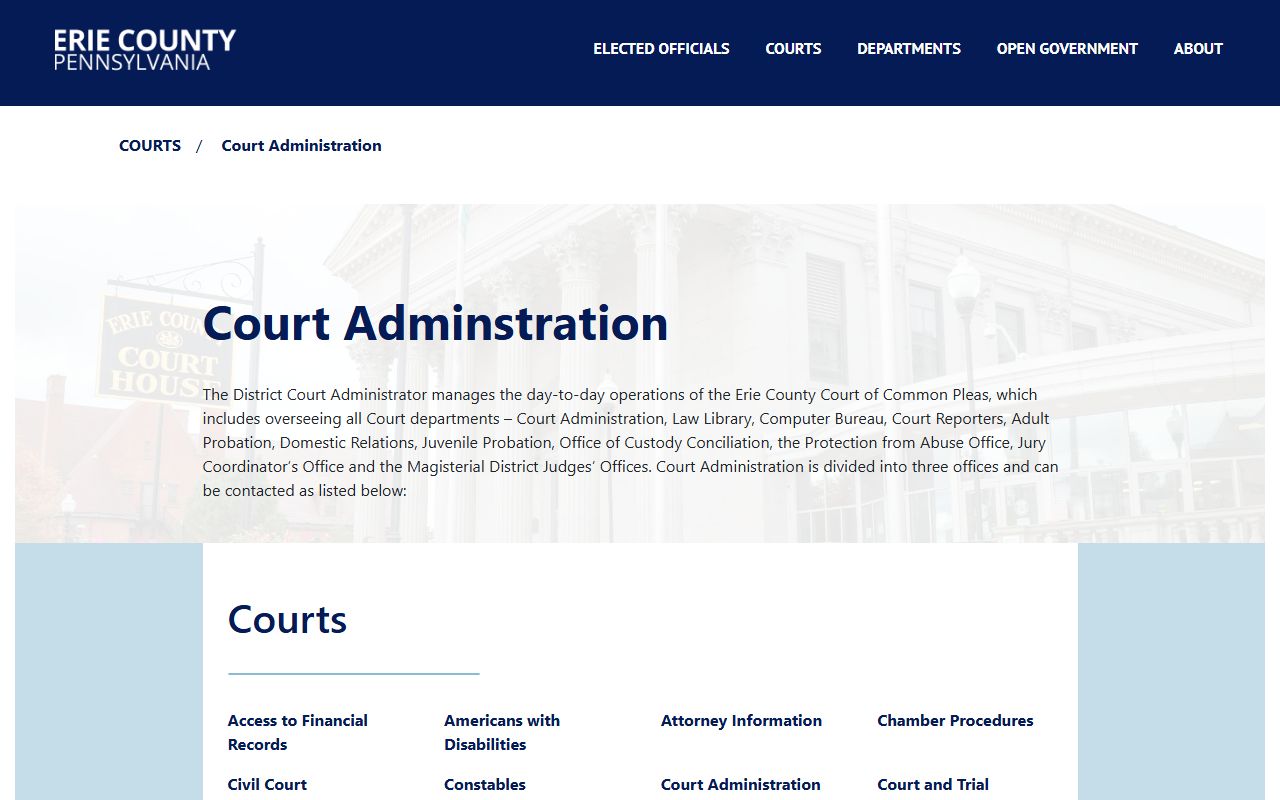
That page confirms the trial court is a nine-judge general-jurisdiction court, which sets the structure for almost every Erie County court records search.
Case flow: Magisterial District Court › Court of Common Pleas › Superior Court › Supreme Court of Pennsylvania
| Court | Jurisdiction | Case Types |
|---|---|---|
| Supreme Court of Pennsylvania | Statewide, court of last resort | Final appeals, select cases |
| Superior Court | Statewide intermediate appeals | Most criminal and civil appeals |
| Commonwealth Court | Statewide | Government and agency matters |
| Court of Common Pleas | Erie County, Sixth District | Felony, civil, family, probate |
| Magisterial District Courts | Local Erie districts | Traffic, summary, small civil, landlord-tenant |
The two levels do different jobs, and the table below shows the split that matters most for record searches.
| Court of Common Pleas | Magisterial District Court | |
|---|---|---|
| Civil cases | Major civil, divorce, judgments | Small claims, landlord-tenant |
| Criminal role | Felony and misdemeanor trials | Arraignment, bail, preliminary hearing |
| Records custodian | Prothonotary and Clerk of Courts | The local MDJ office |
| Appeals | To Superior Court | To Court of Common Pleas |
For the full list of trial judges and magisterial offices, see the Erie County Court of Common Pleas page.
Erie County Courthouse
The Erie County Courthouse anchors the county's court system in downtown Erie, near Perry Square. It holds the Court of Common Pleas, the civil and criminal record offices, the Register of Wills, the Marriage Bureau, and the Sheriff. Each office sits in its own room, so it helps to know the room before you go.
Erie County Courthouse
140 West Sixth Street
Erie, PA 16501
814-451-6000
TDD: 814-451-6237
The courthouse sits at 140 West Sixth Street in the downtown civic block, near Perry Square. Use the street address for navigation, then route inside to the right room for your record.
| Office | Room and Phone |
|---|---|
| Prothonotary (civil) | Room 120, 814-451-6250 |
| Clerk of Courts (criminal) | Room 103, 814-451-6221 |
| Register of Wills (probate) | Room 122, 814-451-6260 |
| Marriage Bureau | Room 123, 814-451-6264 |
| Sheriff | Room 400 |
Types of Court Records Available in Erie County
Erie County court records cover several case types, and each lands with a different custodian. The Clerk of Courts holds criminal files. The Prothonotary holds civil and divorce files. Probate and marriage records route through the Register of Wills and Orphans' Court offices. Magisterial district courts hold most traffic and small claims.
The list below shows the main record groups you can look up.
- Criminal records - felony and misdemeanor cases, held by the Clerk of Courts.
- Civil records - lawsuits, judgments, liens, and name changes, held by the Prothonotary.
- Family and divorce records - divorce, custody, and PFA cases at the Prothonotary, with limits on what is public.
- Probate records - wills and estates through the Register of Wills, dating to 1823.
- Traffic records - citations and summary cases, mostly at the magisterial district courts.
What Erie County Court Records Show
A docket sheet is a public summary of a case. It lists the parties, the charges or claims, the events, and the outcome. It does not always include copies of the filed documents. For full copies, you contact the office that holds the file.
| Field | What It Shows |
|---|---|
| Case Number | CP for Common Pleas, MJ for magisterial, or an appellate format |
| Filing Date | When the case or charge was filed |
| Parties | Commonwealth, plaintiff, defendant, petitioner, or respondent |
| Charges / Cause | Statute, grade, and a short description |
| Disposition | The current or final outcome of each charge |
| Sentence / Judgment | Penalty, money award, fines, costs, or restitution |
Note: Sensitive items such as Social Security numbers, minors' names, and abuse-victim contact details are redacted or filed under confidential procedures.
Public Access Laws for Erie County Court Records
Pennsylvania does not use one single rule for all records. County agency records follow the Right-to-Know Law. Court case records follow the Unified Judicial System's public access policy. Criminal history reports come from the state police, not the court. Each path has its own forms and limits, so it helps to know which one you need.
The Pennsylvania courts post their case-record rules online, and the public record policies page links the case-record access policy and the public forms.
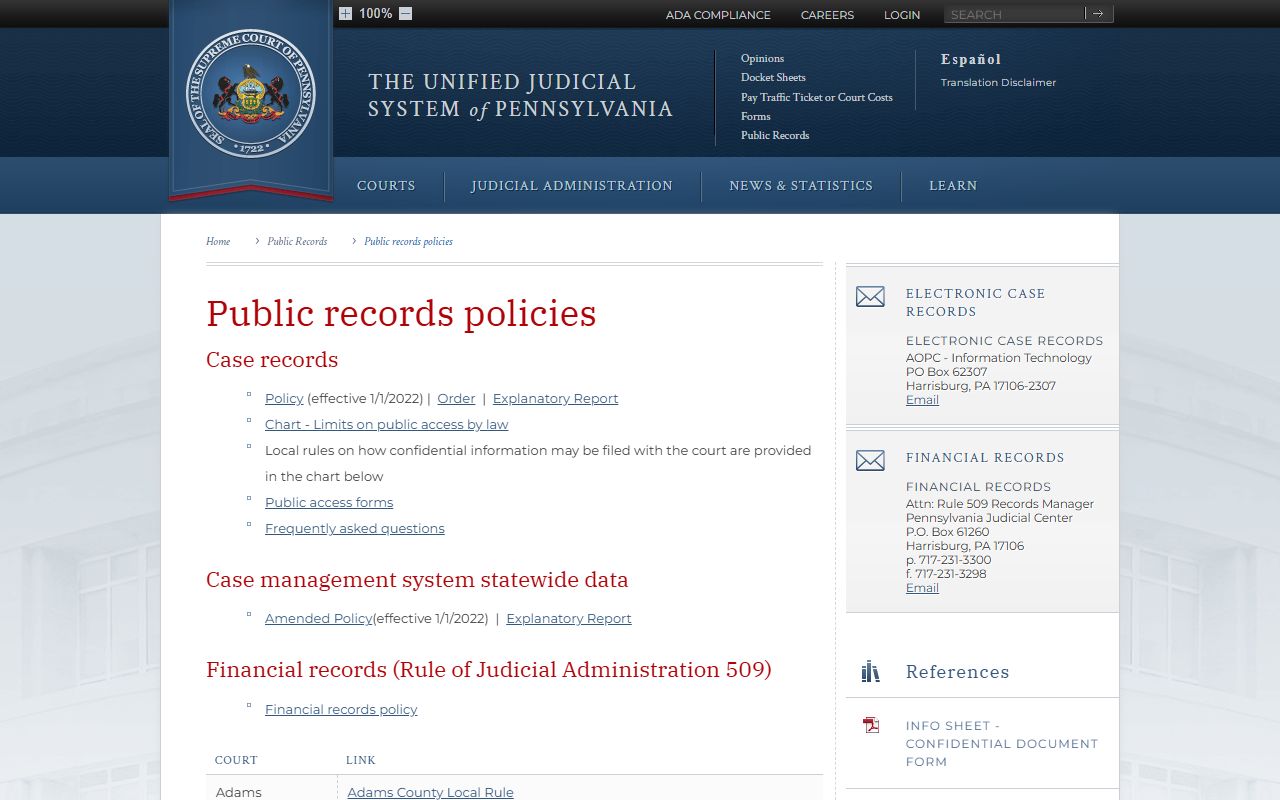
Those policies are why some docket details are visible while full documents and confidential items are not.
Key Statutes:
204 Pa. Code § 213.81 - the UJS Case Records Public Access Policy that governs court dockets.
65 P.S. § 67.101 - the Right-to-Know Law for county agency records, not court files.
18 Pa.C.S. § 9122 - expungement of certain criminal history records.
42 Pa.C.S. § 6307 - keeps most juvenile court files out of public view.
20 Pa.C.S. § 711 - gives Orphans' Court its estate and guardianship jurisdiction.
The core court-record rule is published in the Pennsylvania Code itself.
You can read the Case Records Public Access Policy at 204 Pa. Code § 213.81, which governs what court dockets show and protect.
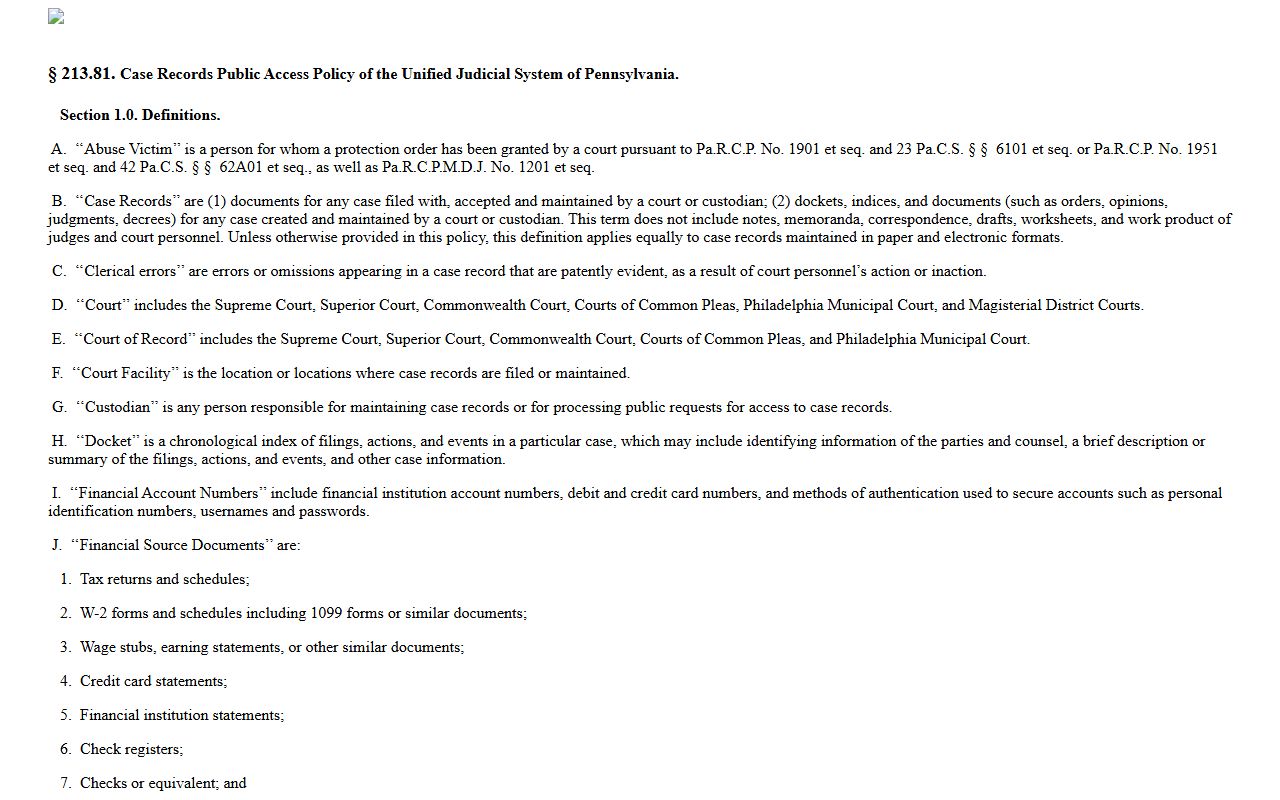
That policy is the reason a docket can list events while full documents and confidential details stay protected.
For the broader framework, the state keeps a public records landing page with statewide data and access guidance.
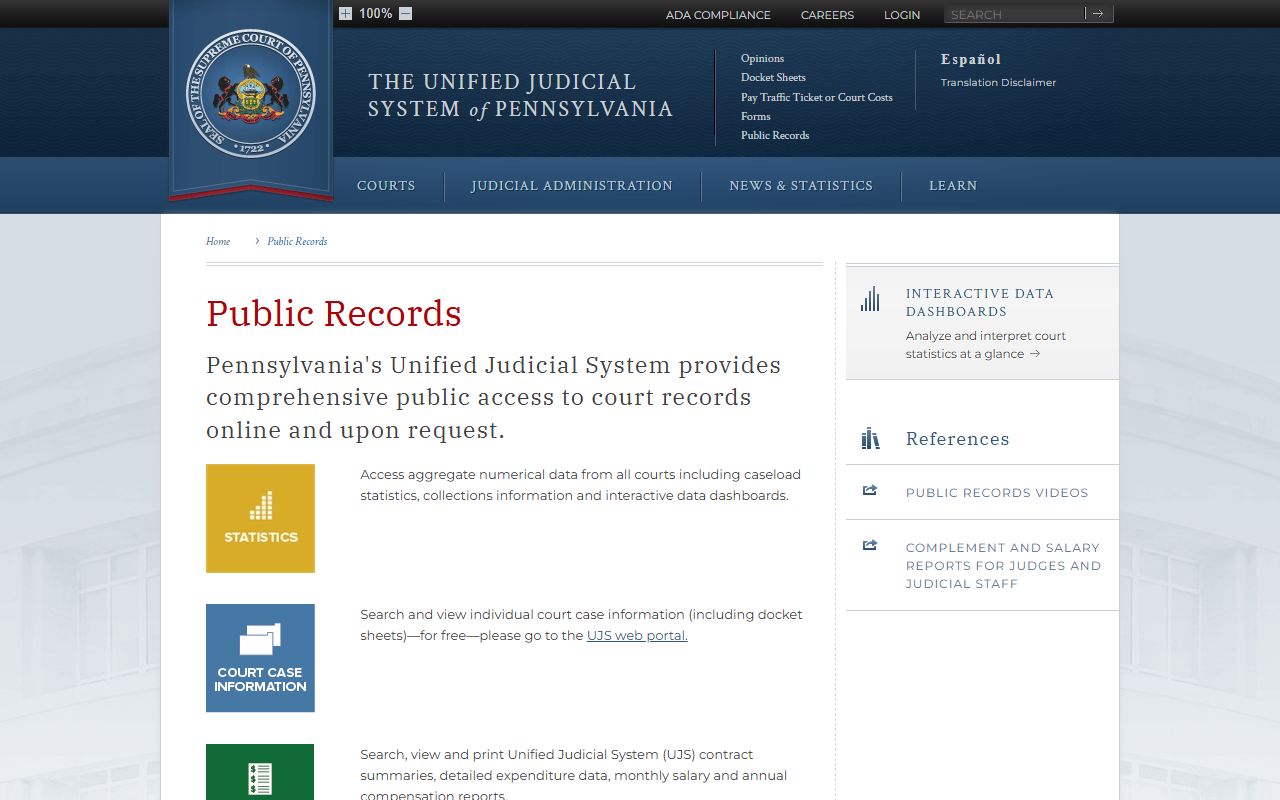
It is the place to start when a request crosses both court and agency record lines.
Records That Are Restricted or Confidential
Some Erie County records are closed to the public. Juvenile court files are limited under state law. Adoption records are sealed. Expunged and limited-access criminal cases drop out of public search results. Mental health commitment records are confidential. A "no result" in a search can mean the case is restricted, not that it never existed.
To view a sealed record, a person usually needs a court order. The custodian cannot simply hand over a confidential file. For expungement or limited access, the Clerk of Courts lists the petition forms and instructions you would file.
Specialty Courts in Erie County
Erie County runs problem-solving courts as an option for some defendants. Treatment Court works to keep people out of jail through drug, alcohol, or mental health treatment. The team includes a judge, lawyers, probation officers, and counselors. Participants face random testing, regular court review, and sanctions for noncompliance.
The county also runs a Veterans Treatment Court for justice-involved veterans and a Family Dependency Treatment Court for parents in dependency cases. These programs pair court supervision with treatment and services.
Pennsylvania's broader court structure is explained on the state courts overview page, which covers each court level from magisterial up.
Specialty courts sit within the Court of Common Pleas, so their records still route through the trial court system.
Erie County Sheriff and Jail
The Erie County Sheriff's Office works out of Room 400 in the courthouse. Sheriff Chris Campanelli was elected in 2022. The office handles court security, civil process, warrant enforcement, and prisoner transport. It has about 40 full-time deputies plus support staff. The Erie County Prison, a separate facility, sits at 1618 Ash Street.
The Sheriff's Office has warned about a phone scam. A caller using a false name has threatened arrest over missed court dates and demanded money. The office says it will never call asking for money to avoid arrest. Verify any such call at 814-451-6007.
For the current roster and booking details, see Erie County inmate records. To check court and warrant status, see warrant records.
Marriage, Divorce, and Orphans' Court
Marriage and probate records both run through the Clerk of Records offices. Marriage records date to 1885. Probate records go back to 1823. Divorce files sit with the Prothonotary on the civil side. See marriage and divorce records and Orphans' Court records for the full process.
- Testator
- A person who makes a will.
- Executor
- The person named in a will to settle the estate.
- Intestate
- Dying without a valid will.
- Guardian
- A person the court appoints to act for someone who cannot act for themselves.
Erie County Court Records Fees
Fees depend on the office and the record type. There is no single price for every certified copy. The county does publish several common fees, listed below. Other amounts come from each office's own fee schedule.
| Item | Amount |
|---|---|
| Staff-conducted record search (Clerk of Records) | $20 |
| Adult criminal record search (Clerk of Courts) | $10 |
| Bail bond filing fee | $16.50 plus the bond amount |
| Summary appeal from an MDJ decision | $43.50 non-refundable |
| Certified marriage record | $5 |
You can search office records yourself for free; the $20 fee applies only when staff run the search.
How to Interpret Erie County Court Records
Docket language can look like code at first. A charge is not a conviction. A disposition is the outcome. Knowing a few terms makes a docket far easier to read.
- Docket
- The chronological list of events in a case.
- OTN
- Offense Tracking Number, which follows a criminal case across court levels.
- Disposition
- The final or current result of a charge.
- Bench warrant
- A warrant a judge issues, often for a missed court date.
- Continuance
- A postponement of a scheduled hearing.
For a deeper walkthrough of docket fields and codes, see Erie County court dockets.
Accuracy and Record Limitations
Online dockets update on a delay, and they do not hold every document. Erie County moved its civil records to CourtPro in April 2024, and older filings stopped going into the prior INFOCON system. If a civil case looks missing from an old tool, check CourtPro or call the Prothonotary before you assume it was dismissed.
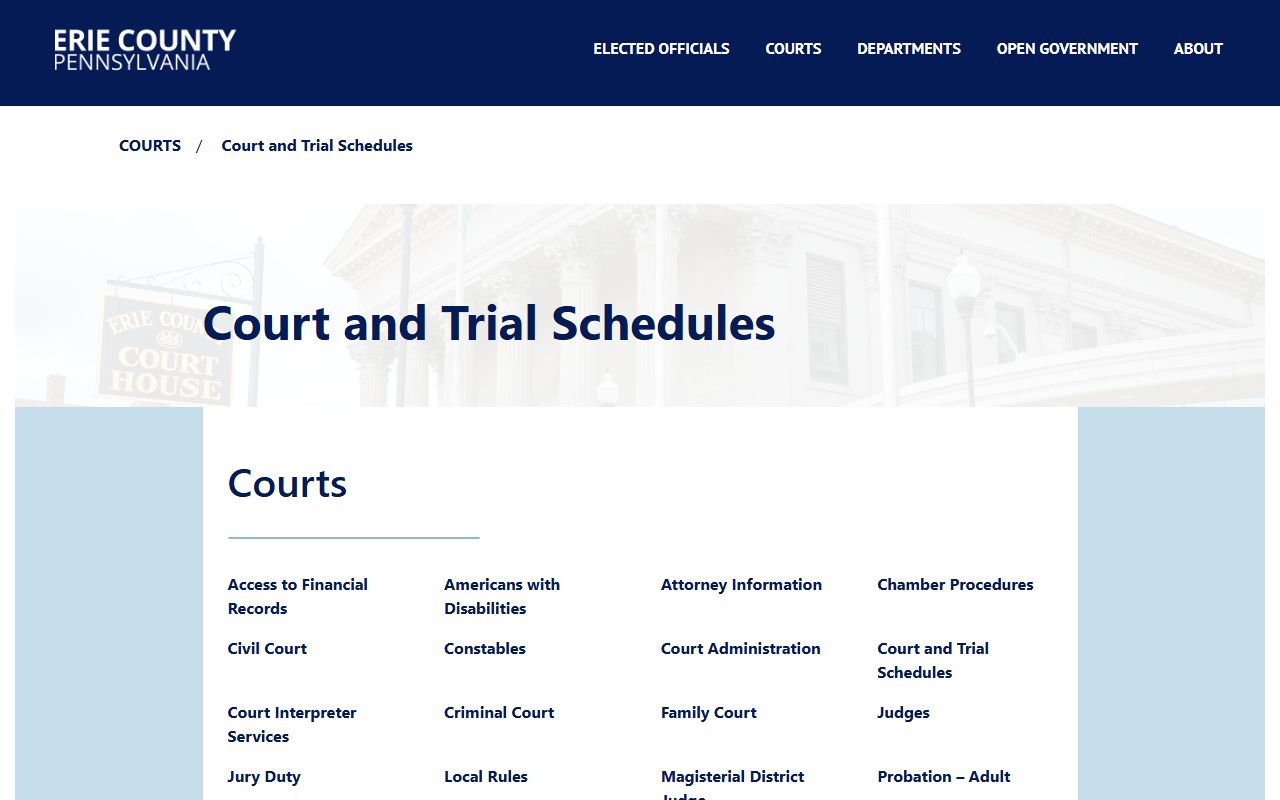
The county posts hearing dates and trial lists on its court schedules page, which is separate from the docket record itself.
Note: Always confirm a case detail with the office that holds the file before you rely on an online record for any legal purpose.
History of Erie County Courts
Erie County's court records reach far back. Probate files date to 1823, and marriage records to 1885. The Sheriff's Office traces its line of sheriffs to Wilson Smith in 1803. The modern trial court is a nine-judge Court of Common Pleas. Downtown Erie holds three court anchors: the county courthouse at 140 West Sixth Street, the federal courthouse at 17 South Park Row, and the county prison at 1618 Ash Street.
Frequently Asked Questions
Where do I search Erie County criminal court records?
Use the UJS Case Search or the Common Pleas docket sheets for public criminal records. The Clerk of Courts in Room 103 is the local custodian and runs adult criminal record searches for a $10 fee. See arrest records for the full process.
What is the difference between the Prothonotary and Clerk of Courts?
The Prothonotary is the civil clerk. The Clerk of Courts is the criminal clerk. Civil, divorce, and judgment records go to the Prothonotary, while criminal motions, bail, and appeals go to the Clerk of Courts.
Can I look up Erie County inmates online?
Erie County posts an official inmate roster and gives 814-451-7500 as the prison information line. Staff can answer questions about charges, bond, visits, and money. See inmate records for details.
More on the Erie County Court Records FAQ page.